NCE · Aligned to the NBCC NCE Outline
NCE Complete Pass System

The Adaptive Platform1 / 3
$25.00/mo · $149.99 billed once · 6 months of access
- 1,520 exam-style questions on the NBCC NCE outline
- 3 timed mock exams, 200 questions each
- Verified against the ACA Code of Ethics and DSM-5-TR
- Adaptive Practice that targets your weakest content areas
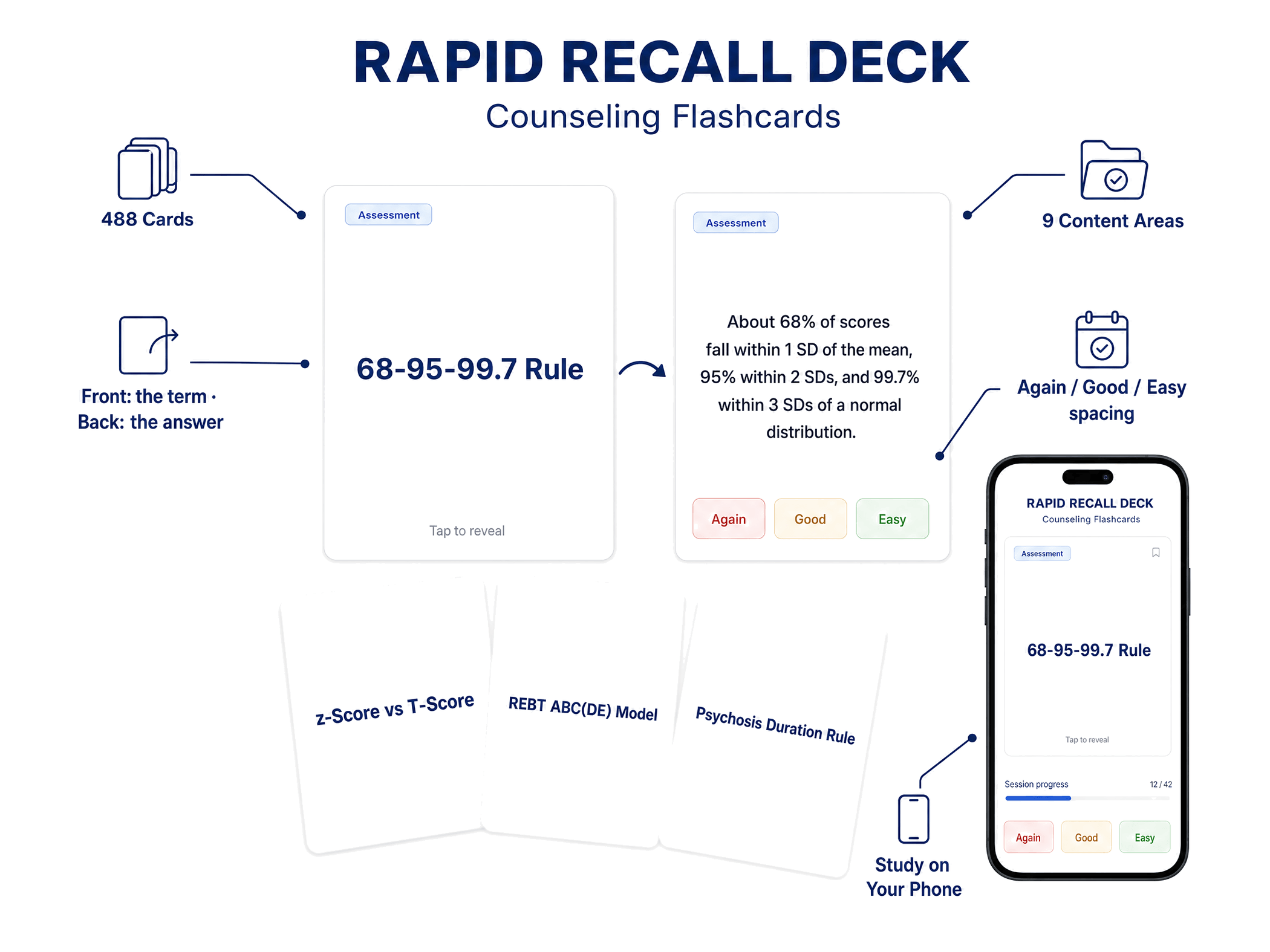
- 488 Rapid Recall flashcards across 9 content areas
- Detailed rationale with every answer
- Reviewed by National Certified Counselors (NCC)
- Pass Guarantee on every Complete Pass System plan
Access length
One-time payment · 6 months · No subscription
- Instant access
- Phone, tablet & desktop
- Secure checkout

The Pass Guarantee
- Complete the study plan and all three mock exams, then sit your exam
- If you don't pass, your plan extends free for the same length you bought
- Send your score report within 30 days of your exam date
- Included with every Complete Pass System plan
Access and delivery
- Login details arrive by email within 5 minutes of purchase.
- Fixed access length, no auto-renewal.
- Every update published during your access is included.
- Works on phone, tablet and desktop.
Employer reimbursement
- Many employers cover exam prep as professional development.
- Every purchase comes with a receipt; custom invoices on request.
1,520
Exam-style questions
Aligned to the NBCC NCE Outline
3
Mock exams
488
Flashcards
9 content areas
The NCE Complete System
What’s in the box
Two formats, one NBCC outline. The QBank builds the ethical and diagnostic judgment the exam rewards; the deck makes the theories and stages automatic.
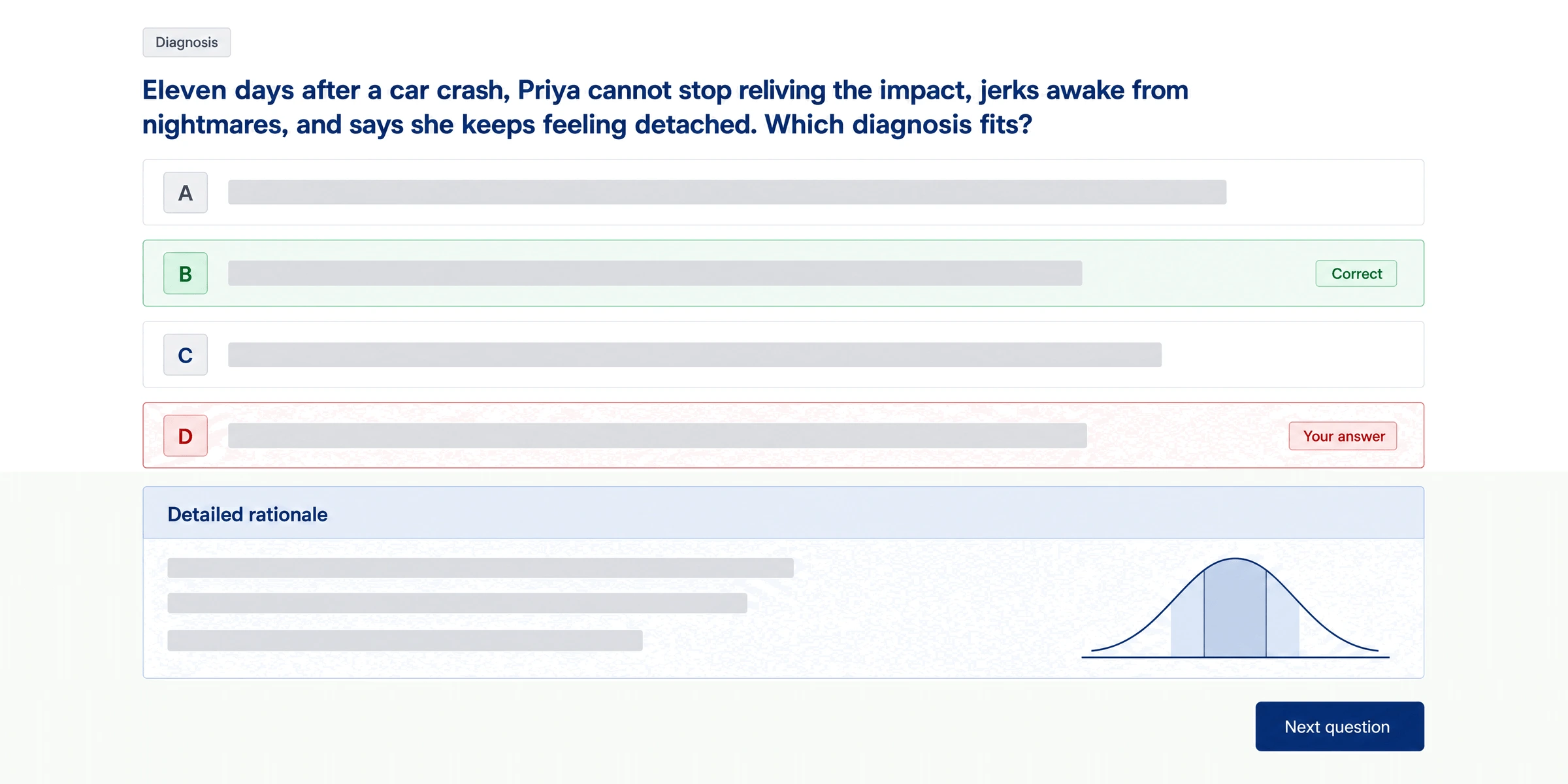
Practice that studies you back
Every session feeds the engine — it learns what you miss and rebuilds your next session around it.
Answer questions and the bank quietly rebalances — your weakest content areas get more reps, automatically, after every single session.
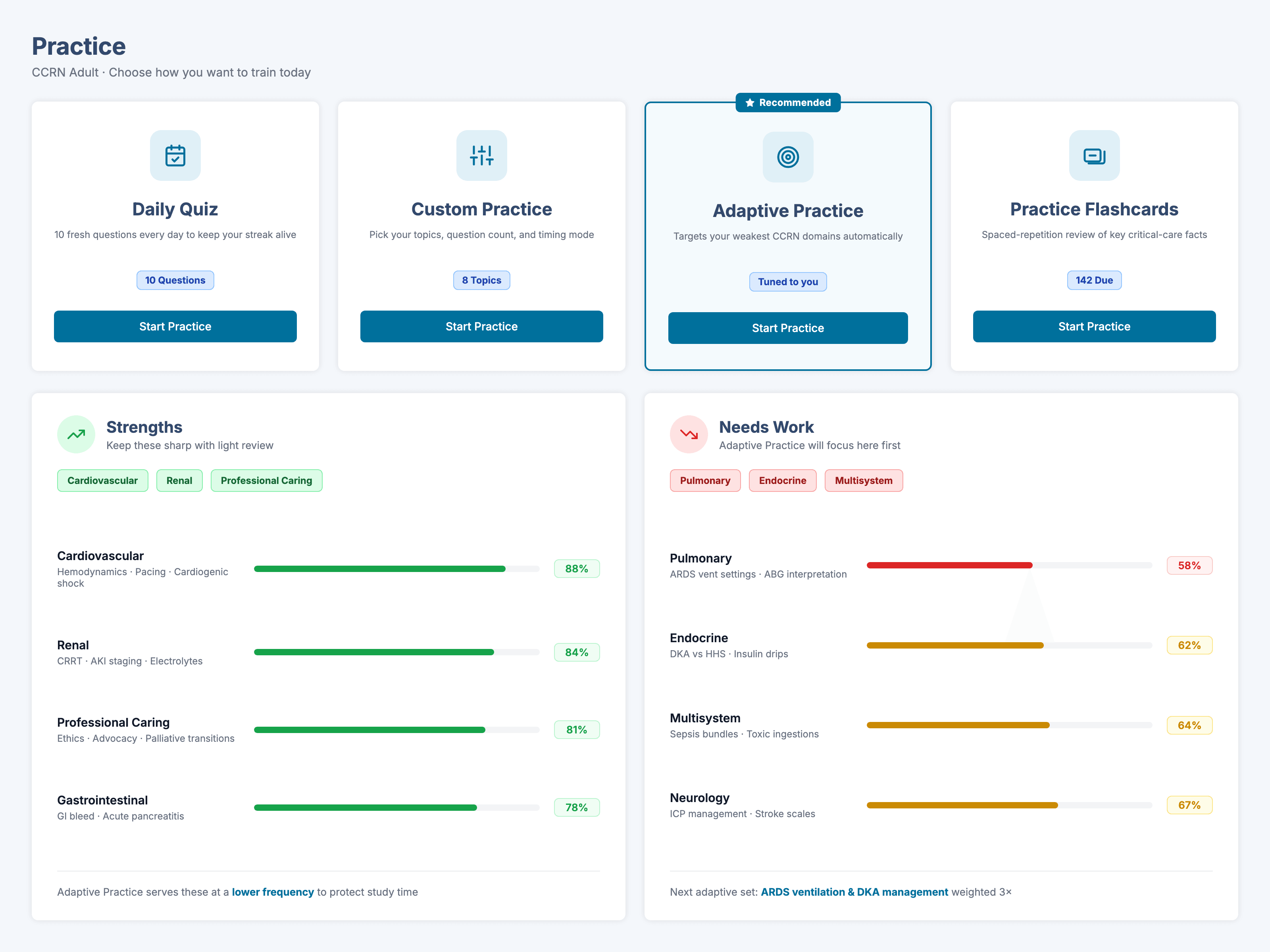
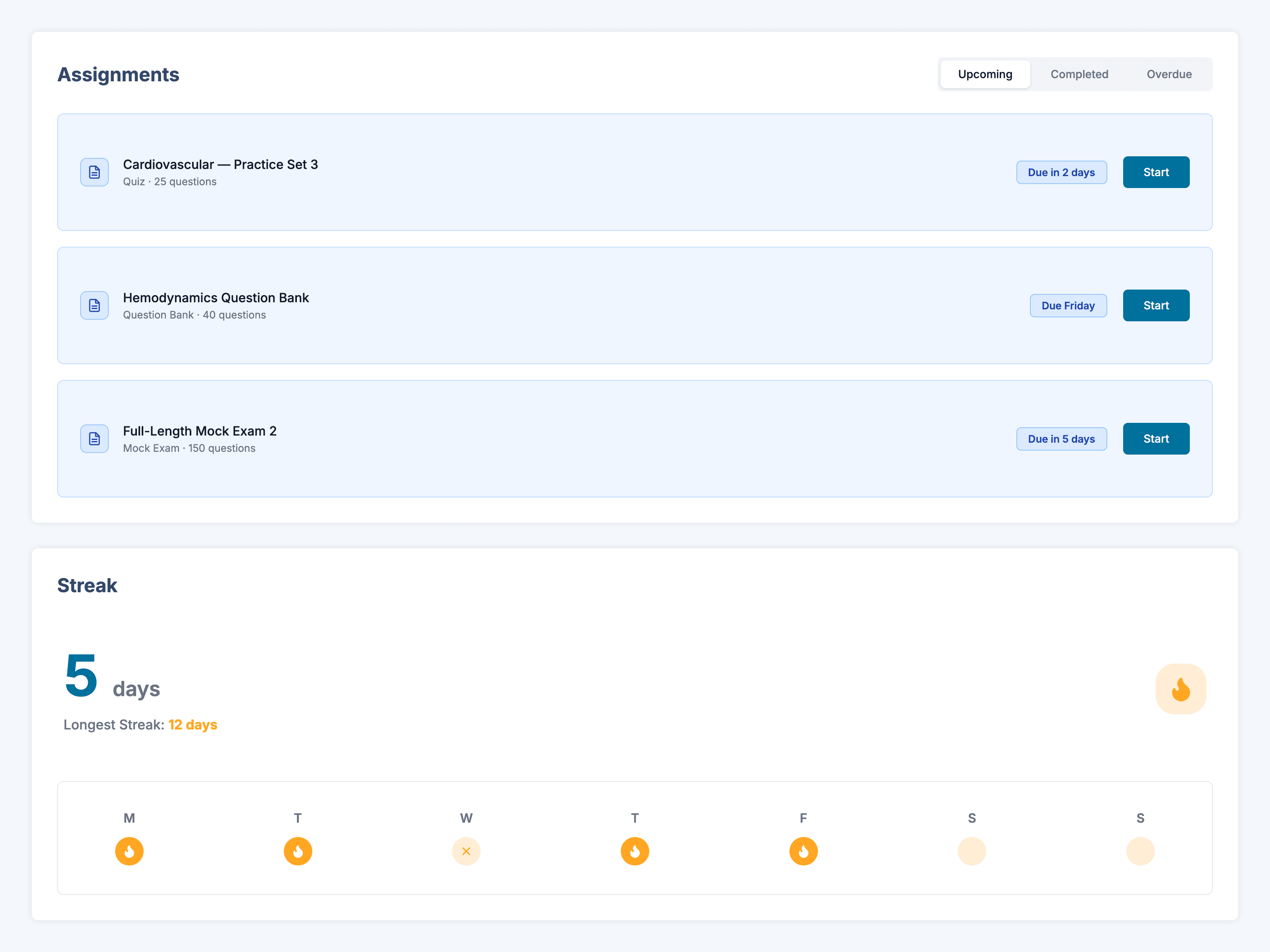
Daily quizzes, assigned practice sets, and a streak that keeps you honest between practicum hours and coursework.
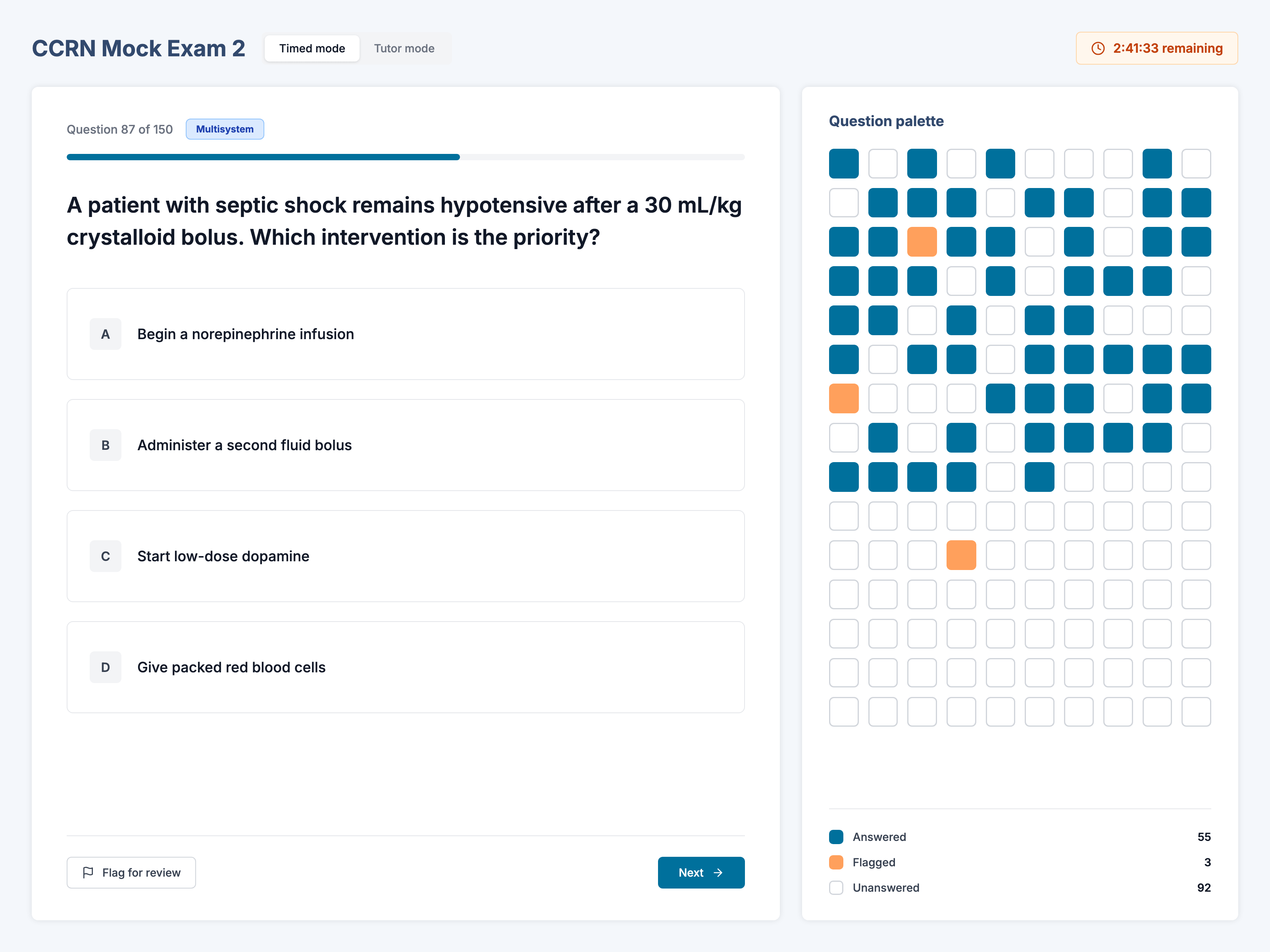
Three full-length timed mocks with a countdown clock, a question palette, and flagging — the same rhythm as test day.
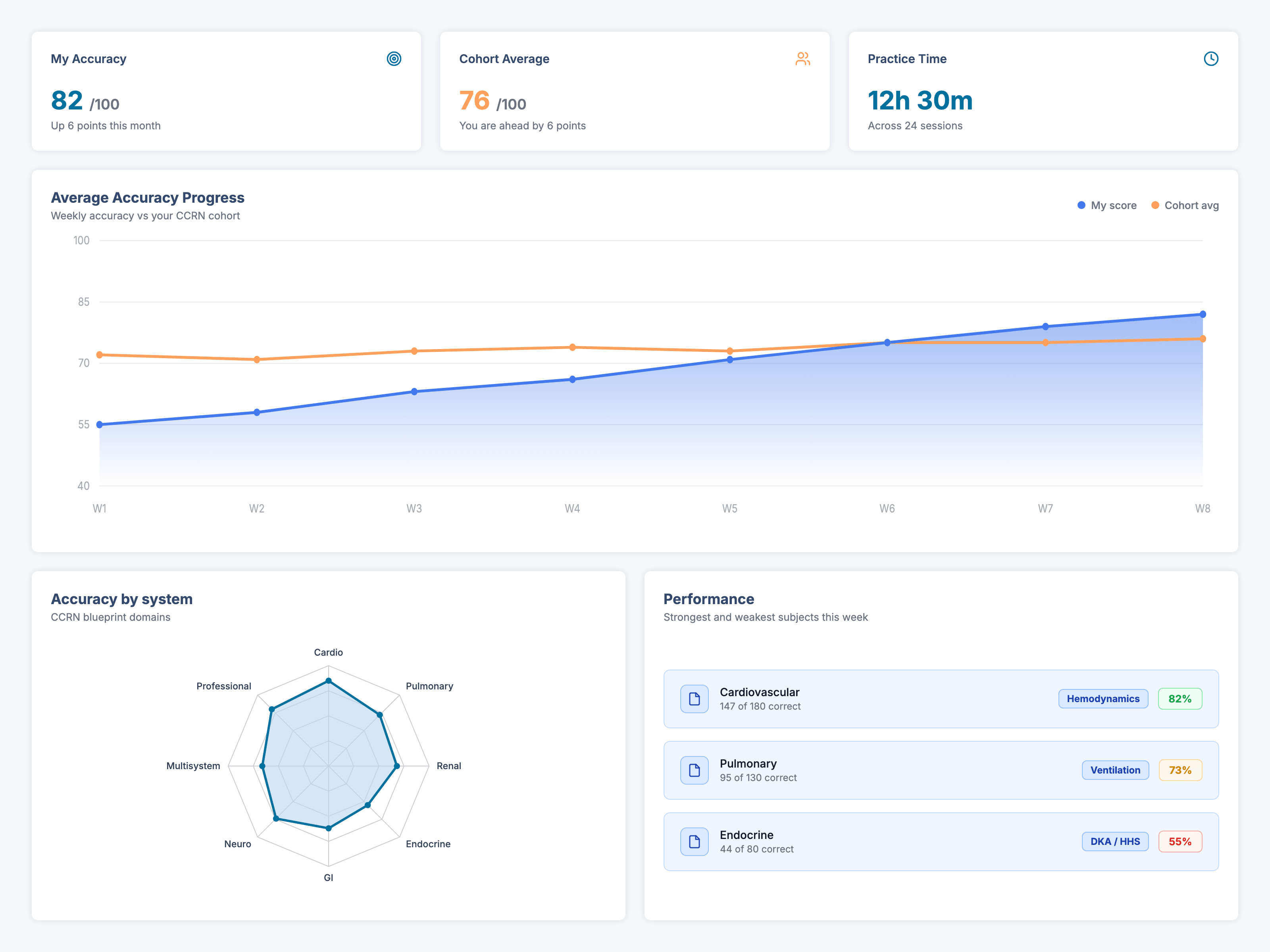
One readiness score, a week-by-week trend, and per-area accuracy — so "am I ready?" stops being a feeling.
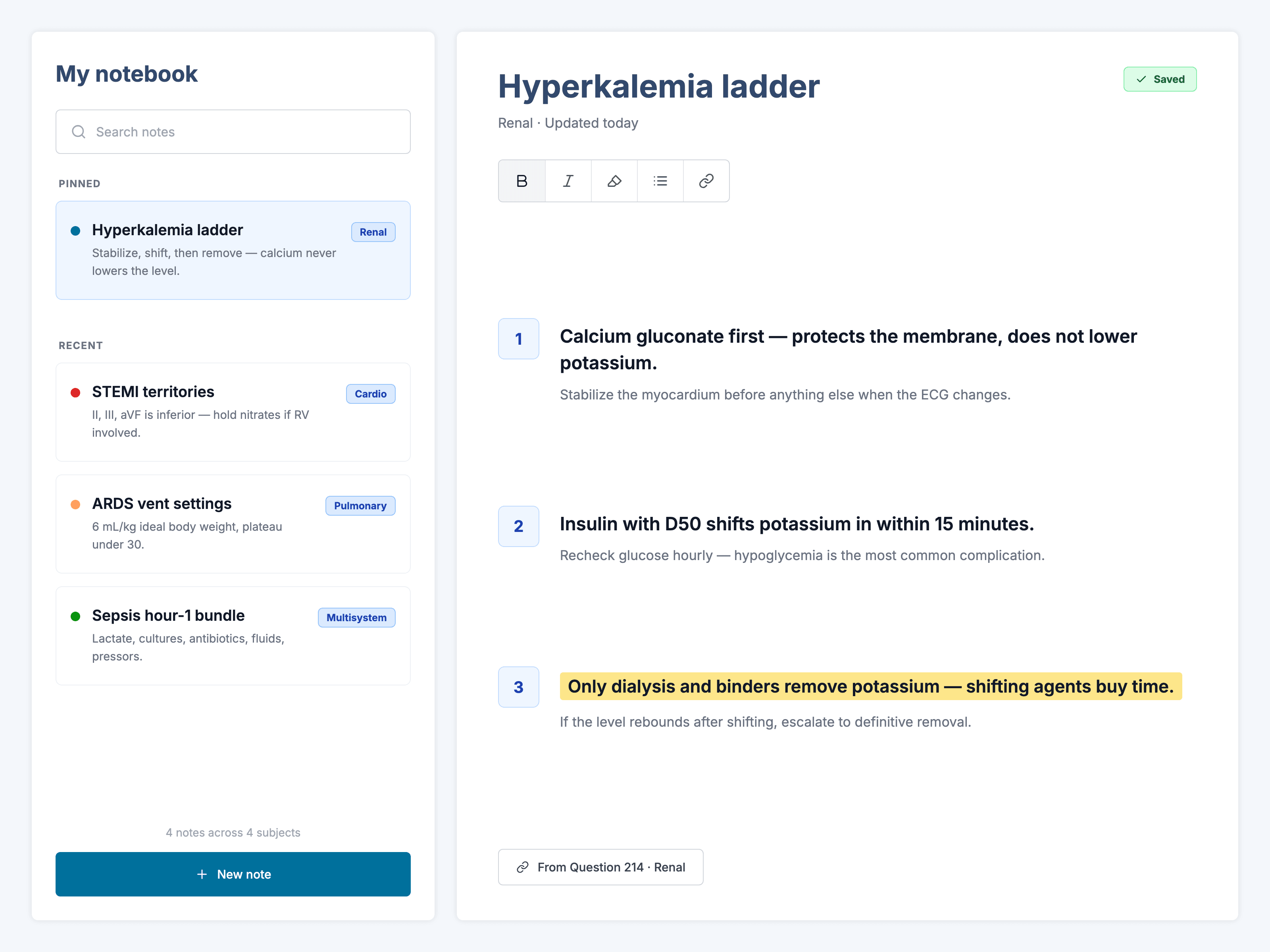
Highlight inside any explanation and save it as a note. Every note stays linked to the question it came from.
488 flashcards, zero filler
The theories, timelines, and statistics the NCE expects on reflex — tagged by content area.
- Assessment
z-Score vs T-Score
z: mean 0, SD 1. T: mean 50, SD 10 (T = 50 + 10z), so z = +1.5 equals T = 65. T-scores avoid negatives — common on the MMPI.
- Theories
Rogers's Core Conditions
Unconditional positive regard, empathic understanding, and congruence — necessary and sufficient for growth in person-centered therapy.
- Theories
REBT ABC(DE) Model
A = activating event, B = belief, C = consequence; D = disputing the irrational belief, E = effective new philosophy. The belief drives the consequence.
- Diagnosis
Psychosis Duration Rule
Brief psychotic disorder: 1 day–1 month, full return. Schizophreniform: 1–6 months. Schizophrenia: 6+ months with 1+ month of active symptoms.
- Diagnosis
Bipolar I vs II vs Cyclothymia
Bipolar I: at least one full manic episode. Bipolar II: hypomania plus major depression, never mania. Cyclothymia: 2+ years of subthreshold swings.
- Diagnosis
ASD vs PTSD vs Adjustment
Acute stress disorder: trauma symptoms 3 days–1 month. PTSD: past 1 month. Adjustment disorder: out-of-proportion distress from an ordinary stressor.
- Ethics
Tarasoff Duty
Tarasoff v. Regents (1976): duty to protect identifiable victims of a client’s serious threat — broadened from the 1974 duty to warn.
- Ethics
Jaffee v. Redmond (1996)
The US Supreme Court recognized psychotherapist–client privilege in federal courts, extending it to licensed therapists.
- Development
Piaget's Four Stages
Sensorimotor (0–2), Preoperational (2–7), Concrete Operational (7–11), Formal Operational (11+). Order is fixed; rates vary.
- Development
Worden's Tasks of Mourning
Accept the reality of the loss; process the pain; adjust to a world without the deceased; find an enduring connection while moving forward.
- Career
Holland RIASEC Types
Realistic, Investigative, Artistic, Social, Enterprising, Conventional — best fit when person and environment types match (congruence).
- Career
Super's Life-Span Stages
Growth (to 14), Exploration (15–24), Establishment (25–44), Maintenance (45–64), Disengagement (65+). People recycle after career changes.
- Group Work
Tuckman's Five Stages
Forming → Storming → Norming → Performing → Adjourning. Storming is conflict; Norming is cohesion; Performing is productive work.
- Diversity
Sue's Microaggression Subtypes
Micro-assault (deliberate), micro-insult (demeaning), micro-invalidation (dismisses lived experience) — brief slights sending hostile messages.
- Research
Cohen's d Benchmarks
Roughly 0.2 small, 0.5 medium, 0.8 large — the difference between two means expressed in standard-deviation units.
Sixteen cards from the live deck, lightly compressed to fit the card face. Every card in the product carries the full detail.
The Pass Guarantee
Complete the plan and the mocks. If you don't pass, you keep studying free.
If you complete the study plan, take all three mock exams, and don’t pass, we extend your plan free for the same length you bought — a 3-month plan gets 3 more months, a 6-month plan gets 6, a 12-month plan gets 12.
- 1
Finish your study plan and all three mock exams.
- 2
Sit the exam. If you don’t pass, send your score report within 30 days.
- 3
Your plan extends free for the same length you bought.
Included with every Complete Pass System plan.
What the NCC is worth
Counseling is one of the fastest-growing fields the US government tracks — the demand curve behind the credential is the story here.
Published figures from the cited sources — individual pay varies by market, role, and experience.
Blueprint coverage
6 content areas, weighted the way the NBCC NCE Outline exam weights them.
- Counseling Skills & Interventions30%
- Areas of Clinical Focus29%
- Professional Practice & Ethics12%
- Intake, Assessment & Diagnosis12%
- Treatment Planning9%
- Core Counseling Attributes8%
Frequently asked questions
Everything you need to know about NCE prep.
About NCE prep
The National Counselor Examination is 200 multiple-choice questions — 160 scored plus 40 unscored field-test items — with 225 minutes of testing time, delivered at Pearson VUE centers or online via OnVUE. Six domains drive the scored content, led by Counseling Skills & Interventions (30%) and Areas of Clinical Focus (29%).
There is no fixed published cut score. NBCC sets the passing point with a modified Angoff process and equates it per exam form, so the passing score varies slightly by version — your form’s passing score appears on your score report. Your performance is never judged against other candidates.
It depends on your state board and your goal. The NCE is one of two exam options for NCC national certification and is the exam many states use for initial LPC licensure; some states use the NCMHCE instead, particularly for clinical-level licensure. Check your state in NBCC’s State Board Directory before registering.
Yes — new NCE specifications take effect July 1, 2027: 170 questions with three answer options each, a 100–500 scale with a fixed passing score of 360, and six redefined domains. Everything in this system tracks the current 200-question exam that runs until then.
NBCC requires a minimum 30-day wait before retesting, with a new registration and fee each attempt. On the state licensure route your board determines total attempts allowed; on the certification route you get three attempts within two years of your application. Our per-domain analytics make the retake plan concrete.
No. PrepSolution is an independent study resource. NCE and NCC are marks of the National Board for Certified Counselors. Every question here is original — paraphrase-only with respect to the ACA Code of Ethics and DSM-5-TR, never verbatim, and never reproduced from any exam.
PrepSolution for the NCE
The NCE Complete Pass System is built as a complete prep path: 1,520 practice questions aligned to the NBCC NCE Outline, each with a written rationale, plus 3 full-length mock exams. Every question is written and reviewed by credentialed professionals who hold the NCC, and Complete Pass System plans carry the pass guarantee: finish the study plan and mocks, and if you don’t pass, your access is extended free.
NCE prep starts at $89.99 one-time and runs up to $229.99 for the longest Complete Pass System plan. Every plan is a single payment for a fixed access length — no subscription and no auto-renewal — and current prices are always shown on this page’s pricing section.
Candidates usually weigh PrepSolution against Pocket Prep, AATBS, Mometrix. PrepSolution’s approach: every question is written by credentialed NCC holders, every answer includes a full rationale, plans are one-time payments rather than subscriptions, and the Complete Pass System includes the pass guarantee. When comparing, check question counts, which formats are included at each price, and access length.
About PrepSolution
You’ll receive an email with your login credentials within 5 minutes of purchase. If you don’t see it, check your spam folder or contact support@prepsolution.com.
No. Every plan is a one-time payment. You pay once and get access for the full length of the plan you choose — 3, 6, or 12 months. There are no recurring charges, no auto-renewals, and no hidden fees.
If you complete the study plan, take all three mock exams, and don’t pass, we extend your plan free for the same length you bought — a 3-month plan gets 3 more months, a 6-month plan gets 6, a 12-month plan gets 12. This guarantee is included exclusively with the Complete Pass System.
Yes. If you purchase and decide it’s not the right fit within 24 hours, contact support@prepsolution.com and we’ll process a full refund. No questions asked.
No. PrepSolution is an independent exam preparation company. We are not affiliated with, endorsed by, or sponsored by SHRM, PMI, AACN, or any certification body. Our content is developed based on publicly available exam blueprints and content outlines.
Many candidates come to PrepSolution after a failed first attempt. The most common reason for failure is approaching judgment-based questions with workplace instinct rather than a systematic framework. Start with a diagnostic mock exam to identify your weakest domains, then follow the targeted study plan.
Many employers cover professional development costs including exam prep materials. After purchase, you’ll receive a receipt that can be submitted for reimbursement. Contact support@prepsolution.com if you need a customized invoice.
NCE Complete Pass System
6 months · $149.99Pass Guarantee includedChange plan
Didn't pass last time?
Failing once doesn't mean you can't pass.
Retake rules, real costs, and what to change before you pay the exam fee again.
Read the NCE retake planEmployer paying?
Get your NCE prep reimbursed.
A ready-to-send approval email and the receipt your finance team asks for.
Copy the approval email
NCE Complete Pass System
6 months · Pass Guarantee includedChange access length