PrepSolution

SHRM-CP · Aligned to the BASK 2026

SHRM-CP Complete Pass System

$25.00/mo · $149.99 billed once · 6 months of access

The Adaptive Platform1 / 5

Platform
Video Course
Book
Flashcards
Mock Exams

$25.00/mo · $149.99 billed once · 6 months of access

  • SHRM-CP Video Course (Animated) · 54 lessons · 8 learning tracks · 13+ hours
  • 1,500+ practice questions on the 2026 BASK
  • 3 timed mock exams, 134 questions each
  • Adaptive Practice that targets your weakest BASK topics
  • The Complete SHRM-CP & SHRM-SCP Book: 1,600+ pages
  • 800+ Rapid Recall flashcards across 22 BASK topics
  • Reviewed by SHRM-SCP-certified HR professionals
  • Pass Guarantee on every Complete Pass System plan

Access length

One-time payment · 6 months · No subscription

  • Instant access
  • Phone, tablet & desktop
  • Secure checkout
VISAAMEXPayGPayDISC
The Pass Guarantee
  • Complete the study plan and all three mock exams, then sit your exam
  • If you don't pass, your plan extends free for the same length you bought
  • Send your score report within 30 days of your exam date
  • Included with every Complete Pass System plan
Full terms
Access and delivery
  • Login details arrive by email within 5 minutes of purchase.
  • Fixed access length, no auto-renewal.
  • Every update published during your access is included.
  • Works on phone, tablet and desktop.
  • The video course is view-only online during your access period.
Employer reimbursement
  • Many employers cover exam prep as professional development.
  • Every purchase comes with a receipt; custom invoices on request.
Copy the approval email
  • 54

    animated lessons

    8 learning tracks

  • 13+

    hours of teaching

    92 focused videos

  • 1,500+

    practice questions

    Adaptive QBank

  • 3

    timed mock exams

    134 questions each

  • 1,600+

    book pages

    380 visual diagrams

  • 800+

    flashcards

    Daily recall practice

“The domain analytics showed me I was bleeding points in People, not everywhere — so I stopped re-reading everything and drilled that one domain. Six weeks later I walked out with a pass.”
Priya M. · SHRM-CP

The SHRM-CP Complete System

What’s in the box

Begin with animated lessons, apply the idea in the QBank, look it up in the visual book, and bring it back with flashcards. Four connected formats for your SHRM-CP preparation.

Video course

SHRM-CP Video Course (Animated)

54 animated lessons cover HR knowledge, situational judgment, employment law, and exam preparation. Watch worked examples, then apply what you learn in the QBank.

Full curriculum

SHRM-CP Video Course (Animated)

8 tracks · 54 lessons · 92 videos · 13h 41m

Open a track to see its lessons.

Track A

Exam and Study Roadmap

3 lessons4 videos39m

Get oriented to the SHRM-CP exam, connect its blueprint to this course, and build a plan around your starting point. Use the Day-0 Diagnostic, question practice, and recall to give each study session a clear purpose.

Begin here. Complete the Day-0 Diagnostic before moving beyond Track A.

  1. A1Your SHRM-CP Exam Roadmap

    Understand the exam's question types, section timing, testing arrangements, and scoring basics. Learn to distinguish dated exam facts from outdated preparation advice.

    12m1 video

    • SHRM-CP Exam Format: What to Expect in 202612m
  2. A2The BASK Blueprint and Your Study Priorities

    Map the eight behavioral competencies and fourteen HR functional areas to the course, and distinguish knowledge, foundational knowledge, and situational judgment questions. Use the course's 15 Percent Map to allocate study time by published exam weights and topic depth while maintaining coverage across the blueprint.

    16m2 video parts

    • Part 1The BASK Blueprint: Competencies, Domains, and Question Types9m
    • Part 2The Study Priority Map: Where to Spend Your Time7m
  3. A3Build a Study System You Can Sustain

    Choose a study plan, use the Day-0 Diagnostic to identify gaps, and connect lesson viewing with question practice, rationale review, and daily recall.

    11m1 video

    • Your Study Plan: Diagnose, Practice, Review, Repeat11m
Track B

SJI Decision Skills

10 lessons19 videos2h 41m

Build a repeatable approach to situational judgment items, or SJIs. Read the ask, recognize the HR role, catch ten recurring answer traps, and compare the final options using the course's PREP, SIEVE, Priority Ladder, and Auditor Test methods.

Complete after Track A. This is the decision-method foundation for the later scenario practice.

  1. B1How SHRM-CP Situational Judgment Works

    Understand how situational judgment answers are developed and why the question asks what an HR professional should do. Separate professional effectiveness from personal preference. Recognize when workplace habits pull you toward an ineffective answer, and practice reasoning within the role, facts, and professional standards given in the scenario.

    17m2 video parts

    • Part 1SJI Scoring: Why the Most Effective Action Wins9m
    • Part 2The SHRM Mindset: Turn Experience into Exam Judgment8m
  2. B2Read the BASK Like a Decision Guide

    Read a proficiency indicator by its action, object, and role level. Use the public framework to predict effective behavior before comparing answer options.

    13m1 video

    • BASK Proficiency Indicators: From Behavior to Best Answer13m
  3. B3Upgrade Your SJI Answer Method

    Apply PREP to a scenario and identify reasonable-sounding distractors that survive a simple eliminate-the-extremes approach. Add action sequencing and role boundaries to PREP, then connect familiar answer traps to the course's ten distractor archetypes.

    16m2 video parts

    • Part 1The PREP Method: Catch Plausible Wrong Answers7m
    • Part 2PREP in Practice: Sequence, Role, and Answer Traps9m
  4. B4Read the Question Before You Choose the Answer

    Distinguish effectiveness, sequence, and diagnosis in question stems. Use the facts to decide when separate fact-finding or a joint discussion fits the situation. Identify the priority and the HR role before choosing an action. Apply the five stem signals to a worked workplace problem.

    18m2 video parts

    • Part 1BEST, FIRST, and ASSESS: Decode the Question Stem9m
    • Part 2PRIORITIZE and ROLE: Find the Decision the Question Needs9m
  5. B5Recognize SJI Answer Traps, Part I

    Identify options that delay necessary action, act before evidence is available, or choose a reasonable step at the wrong time. Recognize unilateral HR decisions and actions pitched at the wrong level of authority. Explain why a useful action can still be the wrong answer.

    18m2 video parts

    • Part 1Answer Traps: Too Passive, Too Early, Wrong Order8m
    • Part 2Answer Traps: Acting Alone and Exceeding Your Role10m
  6. B6Recognize SJI Answer Traps, Part II

    Separate symptoms from process failures, retain the right decision owner, and screen options for legal or ethical defects. Reject options that sound virtuous without specifying an effective action, and recognize when escalation bypasses work HR should first complete.

    18m2 video parts

    • Part 1Answer Traps: Symptoms, Ownership, and Legal Defects9m
    • Part 2Answer Traps: Vague Promises and Needless Escalation9m
  7. B7Eliminate Weak Answers with the SIEVE Check

    Learn the ordered checks for violations, role boundaries, evidence, partnership, and escalation. Use them to test each answer option consistently. Run all five SIEVE gates on a worked consultation question, explain each elimination, and identify the option that survives the full check.

    15m2 video parts

    • Part 1The SIEVE Check: Five Gates for SJI Elimination8m
    • Part 2SIEVE in Action: Work Through a Difficult Scenario7m
  8. B8Choose Between the Final Two Answers

    Use the course's priority ladder to compare competing actions, including safety, compliance, deadlines, and operational needs in a worked labor-relations scenario. Compare the final options through the course's Auditor Test and decide when to use it alongside the Priority Ladder and SIEVE.

    17m2 video parts

    • Part 1The Priority Ladder: Decide What Comes First9m
    • Part 2The Auditor Test: Resolve a Close Final Two8m
  9. B9Practice the Reasoning Behind the Answer

    Eliminate the weakest two options before choosing a winner, then compare your reasoning with a worked employee-retention question. Rank every option by effectiveness, structure short drill sessions, and audit answers you got right for the wrong reason.

    15m2 video parts

    • Part 1Worst-Two-First: Train Your Elimination Skills8m
    • Part 2Rank All Four: Build Better Practice Sessions6m
  10. B10Use Answer Patterns Without Overusing Them

    Use last-sentence-first reading, switchback words, and common answer patterns as starting hypotheses, then test them against the scenario. Examine role ownership, communication channels, and fact-finding patterns. Recognize the facts that change which action is most effective.

    15m2 video parts

    • Part 1SJI Patterns: Reading Clues and Their Limits8m
    • Part 2When the Usual SJI Rule Stops Working8m
Track C

HR Knowledge Core

15 lessons29 videos4h 23m

Work through the People, Organization, and Workplace knowledge domains using focused explanations, worked calculations, and scenario applications. Cover the employee lifecycle, HR operations, global work, risk, technology, corporate responsibility, and employment-law topics.

Study after Track B, using diagnostic placement to prioritize weak areas. Insert relevant Track K lessons as you go.

  1. C1HR Strategy and Business Alignment

    Connect strategic planning, environmental analysis, and scorecard measures. Find the broken link between an HR initiative and the business result it should support. Trace organizational goals into HR action, distinguish Ulrich's HR roles, and calculate return on investment in a worked example.

    16m2 video parts

    • Part 1HR Strategy: Planning, SWOT, and the Balanced Scorecard9m
    • Part 2HR Strategy in Action: Alignment, HR Roles, and ROI7m
  2. C2Talent Acquisition and Fair Selection

    Compare selection methods and recognize employer-coverage and process-timing issues, including employment verification and background checks. Calculate and interpret selection-rate comparisons, diagnose a recruiting funnel, and examine responsibility for third-party screening decisions.

    18m2 video parts

    • Part 1Hiring Decisions: Validity, Coverage, and Compliance Timing9m
    • Part 2Hiring Analytics: Adverse Impact and the Recruiting Funnel9m
  3. C3Employee Engagement and Retention

    Distinguish engagement from satisfaction, examine the manager's role, and choose between stay interviews and exit interviews for the problem at hand. Read early-tenure retention patterns, turn survey findings into action, and calculate turnover measures without confusing the population or denominator.

    17m2 video parts

    • Part 1Employee Retention: Engagement, Managers, and Stay Interviews8m
    • Part 2Retention Analytics: Onboarding, Surveys, and Turnover9m
  4. C4Learning, Development, and Succession

    Match ADDIE phases to their deliverables, distinguish training-evaluation levels, and apply development methods that extend beyond classroom instruction. Separate performance from potential, compare coaching and mentoring, and calculate training ROI in a worked development example.

    17m2 video parts

    • Part 1Learning Design: ADDIE, Kirkpatrick, and 70-20-107m
    • Part 2Talent Development: Nine-Box, Coaching, and Training ROI10m
  5. C5Pay Structures and Wage Decisions

    Work through exemption gates, regular-rate and overtime calculations, and compa-ratio interpretation within a pay structure. Compare lead, match, and lag pay strategies, price roles by their work, and examine equal-pay defenses through a worked employee claim.

    19m2 video parts

    • Part 1Compensation Math: FLSA Gates, Overtime, and Compa-Ratio9m
    • Part 2Pay Decisions: Market Pricing and Equal Pay10m
  6. C6Benefits and Retirement Plan Decisions

    Organize ACA and COBRA requirements into coverage, counting, and timing questions, including a worked full-time-equivalent calculation. Recognize fiduciary duties, distinguish defined-benefit from defined-contribution risk, and compare tax-favored benefit accounts and cafeteria plans.

    17m2 video parts

    • Part 1Benefits Compliance: ACA, FTE Counts, and COBRA8m
    • Part 2Benefits Decisions: ERISA, Retirement Risk, and Accounts9m
  7. C7How the HR Function Delivers Service

    Compare HR business partners, specialist teams, shared-service tiers, and outsourcing models. Interpret the HR cost and staffing ratios used in the lesson.

    15m1 video

    • HR Service Delivery: HRBPs, Shared Services, and Outsourcing15m
  8. C8Organizational Change and Effectiveness

    Match a change problem to the appropriate model and use culture and team-development frameworks to identify what is preventing progress. Distinguish tacit from explicit knowledge, connect organizational structure with process performance, and apply the lesson's worked measures.

    16m2 video parts

    • Part 1Change and Culture: Choose the Model That Fits8m
    • Part 2Organizational Effectiveness: Knowledge, Structure, and Process8m
  9. C9Workforce Planning and Restructuring

    Move from business demand to workforce gaps and staffing options. Examine worker classification and the analysis needed before a reduction in force. Calculate a staffing gap and work through the coverage, notice, and release issues presented in workforce-reduction scenarios.

    18m2 video parts

    • Part 1Workforce Planning: Forecast Gaps and Choose Your Response8m
    • Part 2Workforce Decisions: Gap Math, WARN, and Severance10m
  10. C10Employee and Labor Relations

    Recognize protected concerted activity and distinguish prohibited employer conduct from permitted communication during organizing. Classify bargaining subjects and strike situations, then apply representation rights and discipline principles to workplace decisions.

    18m2 video parts

    • Part 1Labor Relations: Section 7, Organizing, and Employer Conduct8m
    • Part 2Labor Relations in Practice: Bargaining, Strikes, and Discipline11m
  11. C11HR Technology, Analytics, and Data Responsibility

    Distinguish HR technology platforms and analytics levels, interpret an adverse-impact screen, and retain accountability for automated hiring decisions. Examine the technology-law topics taught in the 2026 course, including workplace monitoring, cross-border data, and an employee erasure request.

    18m2 video parts

    • Part 1HR Technology: Systems, Analytics, and AI Accountability8m
    • Part 2HR Data Decisions: AI Rules, Monitoring, and Privacy10m
  12. C12Managing a Global Workforce

    Identify global staffing orientations from behavior, compare cultural dimensions, and plan for the return of international assignees. Work through expatriate compensation, distinguish tax equalization from tax protection, and review the immigration and cross-border compliance topics in the lesson.

    18m2 video parts

    • Part 1Global HR: Staffing Orientations, Culture, and Repatriation7m
    • Part 2Global Assignments: Pay, Tax Approaches, and Work Authorization10m
  13. C13Risk, Safety, and Business Continuity

    Distinguish inherent from residual risk, choose a risk treatment, and separate occupational-safety recording from reporting obligations. Examine workers' compensation risk, recognize workplace-violence categories, and distinguish business continuity, disaster recovery, and recovery measures.

    16m2 video parts

    • Part 1HR Risk: Assess, Treat, and Recognize OSHA Duties8m
    • Part 2Workplace Risk: Workers' Compensation and Continuity8m
  14. C14Corporate Responsibility, Ethics, and Employment Law

    Apply stakeholder and responsibility frameworks, recognize ethics-program elements, and organize employment-law questions by coverage, process, and claim type. Examine harassment defenses, disability and genetic-information issues, leave eligibility, and the court decisions discussed in the course's 2026 review.

    23m2 video parts

    • Part 1CSR and Ethics: Stakeholders, Compliance, and Legal Coverage12m
    • Part 2Employment Law Decisions: Harassment, Accommodation, and Cases10m
  15. C15Broaden Your HR Knowledge Coverage

    Distinguish what a learning system can solve, identify structural causes of wellness problems, and review generational-workforce and position-management concepts. Recognize international labor principles, reason through a scheduling problem, and distinguish systems concepts and organizational-development interventions.

    18m2 video parts

    • Part 1HR Knowledge Review: LMS, Wellness, and Position Management8m
    • Part 2HR Knowledge Review: ILO, Scheduling, Systems, and OD9m
Track K

Knowledge Plus

10 lessons10 videos1h 32m

Use ten focused supplements to strengthen the concepts that need more time than the core lessons allow. Each lesson connects to a Track C topic, from hiring measures and performance systems to pay programs, investigations, and risk calculations.

Take the matching supplement immediately after its Track C lesson when the diagnostic or drill results flag that topic. Watch shared supplements only once.

  1. K1Project Management and Strategic Planning Tools

    Sequence project processes, distinguish project approaches and governance roles, calculate critical path and float, and compare strategic planning tools.

    10m1 video

    • Projects and Planning: Critical Path, Float, and Frameworks10m
  2. K2Hiring Foundations and Selection Measures

    Plan a recruiting funnel backward, distinguish reliability from validity, and review job analysis, employment categories, offer contingencies, and medical-exam timing.

    11m1 video

    • Hiring Foundations: Yield Ratios, Job Analysis, and Validity11m
  3. K3Performance Management and Job Design

    Compare appraisal methods and rater errors, distinguish job-design approaches, and review workplace flexibility, job attitudes, culture types, and vacancy rate.

    10m1 video

    • Performance and Job Design: Ratings, Roles, and Motivation10m
  4. K4Learning Delivery and Career Development

    Compare learning-design and delivery approaches, distinguish development plans from performance-improvement plans, and review career tools, knowledge sharing, and learning technology.

    9m1 video

    • Learning Tools: SAM, Bloom's Taxonomy, and Career Development9m
  5. K5Pay Programs and Wage-Law Foundations

    Compare job-evaluation methods, pay adjustments, incentives, and equity vehicles, then organize the wage-floor and federal-contract topics taught in the lesson.

    9m1 video

    • Pay Programs: Job Evaluation, Variable Pay, and Wage Rules9m
  6. K6Leave, Benefits, and Health Plan Foundations

    Distinguish mandated, government-provided, and voluntary benefits. Compare leave and health-plan designs and review payroll-tax, insurance, and benefits-case concepts.

    9m1 video

    • Benefit Programs: Leave, Payroll Taxes, and Health Plans9m
  7. K7Organizational Structure and Workforce Tools

    Identify organizational structures, use a 7S fit check, recognize group dynamics, and compare HR roles, workforce responses, and gap-analysis tools.

    8m1 video

    • Organization Design: Structures, McKinsey 7S, and Workforce Tools8m
  8. K8Workplace Investigations and Dispute Resolution

    Recognize retaliation concerns, organize an investigation, and compare discipline, mediation, arbitration, grievances, and labor-dispute responses.

    10m1 video

    • Dispute Resolution: Investigations, Discipline, and Arbitration10m
  9. K9Workplace Policies, Safety, and Risk Measures

    Review substance and safety-policy issues, calculate single and annualized loss expectancy, and identify the decisions covered by technology-use policies.

    10m1 video

    • Workplace Policies: Drug Testing, Risk Math, and Technology Use10m
  10. K10Put Corporate Social Responsibility into Practice

    Sequence the CSR implementation process, compare community-engagement approaches, and distinguish shared value from philanthropy while recognizing volunteer-pay issues.

    6m1 video

    • CSR in Practice: Build the Program and Measure Its Purpose6m
Track L

U.S. Employment Law

3 lessons6 videos48m

Bring the course's U.S. employment-law content together in one organized sequence. Connect equal employment opportunity, wages, leave, benefits, labor relations, safety, privacy, and immigration topics to the coverage and process distinctions used in exam questions.

Take after Track C and before Mock 1. The course plans recommend it for everyone and require it for a flagged U.S. Employment Law area. Its jurisdiction is U.S. federal law; it is not a state-by-state survey.

  1. L1U.S. Equal Employment Opportunity Law

    Organize federal EEO questions by coverage, enforcement process, discrimination theory, and harassment or retaliation issue. Compare the protections and accommodation concepts taught in the lesson, including medical inquiries, age discrimination, genetic information, and federal contractors.

    17m2 video parts

    • Part 1EEO Law: Coverage, Discrimination, Retaliation, and Harassment9m
    • Part 2EEO Law: Pregnancy, Disability, Age, and Genetic Information8m
  2. L2U.S. Wage, Hour, Leave, and Benefits Law

    Separate employer coverage from employee eligibility, review FLSA and equal-pay concepts, and distinguish the federal contract-wage laws. Organize benefit-plan and leave questions by coverage, duties, and timing. Review the related health-coverage, military-leave, and social-insurance topics.

    16m2 video parts

    • Part 1Wage and Hour Law: FLSA, Equal Pay, and Contract Wages7m
    • Part 2Leave and Benefits Law: ERISA, COBRA, FMLA, and USERRA8m
  3. L3U.S. Labor, Safety, Privacy, and Immigration Law

    Distinguish the major federal labor acts, check the elements of a WARN scenario, and recognize the exceptions to at-will employment taught in the lesson. Organize safety, substance, monitoring, background-check, and immigration questions by the applicable rule and process, including employment-verification responsibilities.

    16m2 video parts

    • Part 1Labor and Job Security Law: Unions, WARN, and At-Will Rules8m
    • Part 2Workplace Law: Safety, Screening, Privacy, and Work Eligibility8m
Track D

Behavioral Competencies

6 lessons11 videos1h 45m

Translate the eight behavioral competencies into actions you can recognize in a scenario. Practice leadership, ethics, inclusion, relationships, communication, business consultation, and analytical reasoning, then review the theories behind foundational knowledge questions.

Follow Track C and Track L in the standard plan. Use D1–D4 for targeted competency repair, then complete D5 and D6.

  1. D1Leadership and Ethical Practice

    Match leadership behavior to the HR role, build influence without formal authority, and distinguish the leadership and motivation theories taught in the lesson. Recognize recurring pressure patterns and choose a consistent, defensible response. Apply the ethical decision method to a worked scenario.

    19m2 video parts

    • Part 1HR Leadership: Influence, Role Level, and Leadership Theory9m
    • Part 2Ethical HR Decisions Under Pressure10m
  2. D2Inclusive Mindset in Everyday HR Decisions

    Identify structural barriers, compare process changes with symbolic responses, and connect fair decision design to workplace inclusion. Work through an automated-screening audit and distinguish standards that remain constant from practices that should adapt across cultures.

    18m2 video parts

    • Part 1Inclusive HR: Fix Bias Where Decisions Are Made9m
    • Part 2Inclusive Mindset: AI Screening and Cultural Context9m
  3. D3Relationships, Conflict, and Communication

    Map stakeholders, recognize how trust is built, and decide when a conflict requires separate fact-finding before joint problem-solving. Select a communication channel for the audience and task, use media-richness cues, and diagnose why a policy message failed to reach its audience.

    19m2 video parts

    • Part 1HR Relationships: Trust, Stakeholders, and Conflict10m
    • Part 2HR Communication: Audience, Channel, Message, and Listening9m
  4. D4Business Acumen, Consultation, and Analytical Aptitude

    Recognize financial statements and HR costs, express recommendations in business terms, and diagnose a leader's request before proposing a solution. Disaggregate a headline measure, identify possible confounders, and distinguish an association from evidence that supports a causal explanation.

    19m2 video parts

    • Part 1HR as a Business Partner: Financials and Consultation10m
    • Part 2HR Analytics: Break Down the Data Before You Decide9m
  5. D5Recognize the Competency Behind the Scenario

    Recognize the behavioral patterns behind the Leadership cluster and connect them to answer choices in a worked ethics scenario. Complete the eight-competency map and apply Interpersonal and Business cluster patterns to worked scenario questions.

    15m2 video parts

    • Part 1Competency Patterns: Leadership, Ethics, and Inclusion8m
    • Part 2Competency Patterns: Relationships, Communication, and Business8m
  6. D6The Theories Behind Behavioral Competencies

    Distinguish commonly confused competency concepts, label the behavior or model a question describes, and interpret means, medians, and basic charts.

    14m1 video

    • Foundational Knowledge: Theories, Models, and Basic Statistics14m
Track E

Practice and Readiness

4 lessons8 videos1h 12m

Put the decision system to work in guided single-question and scenario-set walkthroughs. Train for fatigue, structure mock-exam review, and use the course's TrueScore and readiness gates to turn practice results into your next study actions.

Use after the knowledge and competency tracks. Schedule Mock 2 after Track E and Mock 3 in the final study week, following the study-plan instructions.

  1. E1Guided SJI Practice: Single Questions

    Run the course's six-step protocol on three questions, commit to your answer, and compare your reasoning with the explanation. Practice the same protocol on the next three questions, identify when action or analysis is required, and audit your reasons for choosing the winner.

    21m2 video parts

    • Part 1Think-Aloud Practice: The First Three SJI Walkthroughs11m
    • Part 2Think-Aloud Practice: Three More SJI Walkthroughs10m
  2. E2Guided SJI Practice: Scenario Sets

    Build one scenario map, carry forward the facts, and answer each question through its own competency lens without importing earlier answer choices. Apply the scenario-set method to the resort case, use shared constraints to eliminate options, and distinguish related job-design concepts.

    20m2 video parts

    • Part 1Scenario Sets: Map the Facts and Reset for Each Question11m
    • Part 2Scenario Sets in Action: Constraints and Changing Lenses9m
  3. E3Timed Practice, Fatigue, and Mock Review

    Recognize signs of intuition replacing procedure, practice a short timed drill, and use a repeatable routine when concentration drops. Place three mock checkpoints in your study plan and use a two-pass review to turn missed or weakly reasoned answers into a repair list.

    17m2 video parts

    • Part 1SJI Under Fatigue: Keep Your Decision Method Working7m
    • Part 2The Mock Exam Method: Schedule, Review, and Repair9m
  4. E4Measure Readiness with TrueScore

    Evaluate what a practice score measures, learn the course's TrueScore calculation, and audit correct answers for weak reasoning. Apply the course's four readiness gates, identify the pattern behind a failed gate, and create a targeted plan for the next practice cycle.

    15m2 video parts

    • Part 1TrueScore: Separate Solid Knowledge from Lucky Answers7m
    • Part 2Readiness Gates: Turn Mock Results into Your Next Steps8m
Track F

Exam Day and Beyond

3 lessons5 videos41m

Prepare your exam-day routine, manage section timing and answer changes, and understand the result-reporting topics covered in the course. For a repeat attempt, use the retake lessons to identify gaps and rebuild your method; after passing, review the next steps for maintaining the credential.

Review near exam day. Returning candidates can start with F2 before re-entering Track A and taking a fresh diagnostic.

  1. F1Your Exam-Day Playbook

    Build a section-by-section pacing plan, prepare for fatigue, and organize the recall sheet demonstrated in the lesson. Use a reason-based answer-change rule, plan around your own attention and language needs, and distinguish the preliminary result from the official report.

    17m2 video parts

    • Part 1Exam-Day Pacing: Section Timing, Stamina, and Recall9m
    • Part 2Exam-Day Decisions: Second-Guessing and the Test Room8m
  2. F2Rebuild Your Plan After an Unsuccessful Attempt

    Use the course's reset routine, read the Candidate Score and Feedback Report, and identify whether knowledge, judgment, or preparation method needs attention. Rebuild your practice approach around diagnostic evidence, avoid unnecessary repeat purchases, and review the retake arrangements covered in the lesson.

    14m2 video parts

    • Part 1Retake Reset: Read Your Score Report and Find the Gaps6m
    • Part 2Retake Strategy: Change the Method and Target the Gaps8m
  3. F3Understand Your Score and What Comes Next

    Interpret the limits of a scaled score, understand the results-review process discussed in the course, and identify the next steps after earning the credential.

    9m1 video

    • SHRM-CP Results: Scaled Scores and Recertification9m

Runtimes are rounded to the nearest minute. Practice and review time is additional.

lessons
54
animated videos
92
learning tracks
8
of instruction
13h 41m

Watch online throughout your 3-, 6-, or 12-month Complete Pass System access. The course is view-only; video downloads are not included.

Inside the course

The SHRM-CP Platform

Practice that studies you back

Every session feeds the engine — it learns what you miss and rebuilds your next session around it.

Answer questions and the bank quietly rebalances — your weakest knowledge domains get more reps, automatically, after every single session.
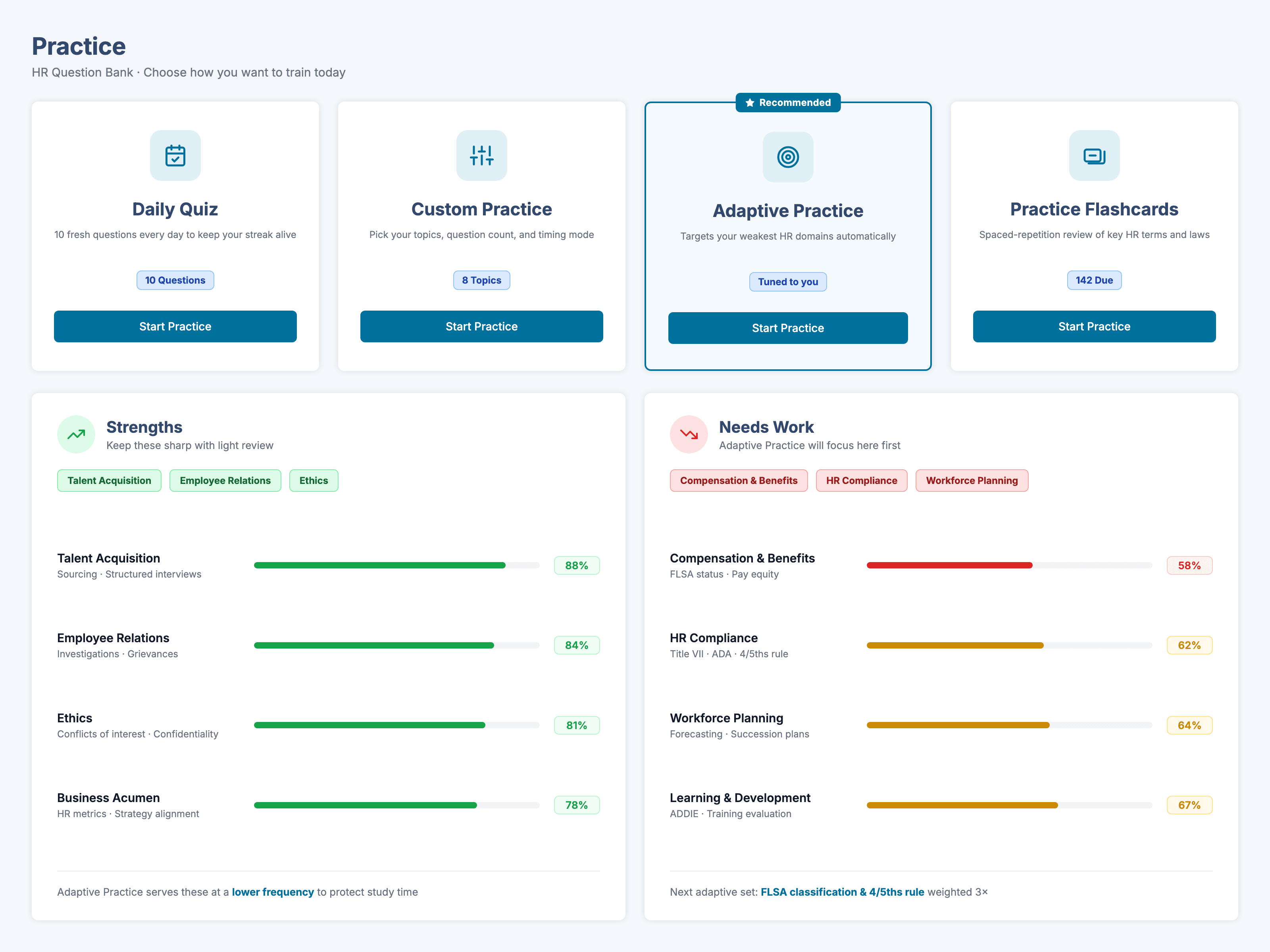
The practice picker with Adaptive Practice recommended, above strengths and needs-work panels with per-domain accuracy bars

Daily quizzes, assigned practice sets, and a streak that keeps you honest on workdays and weekends alike.
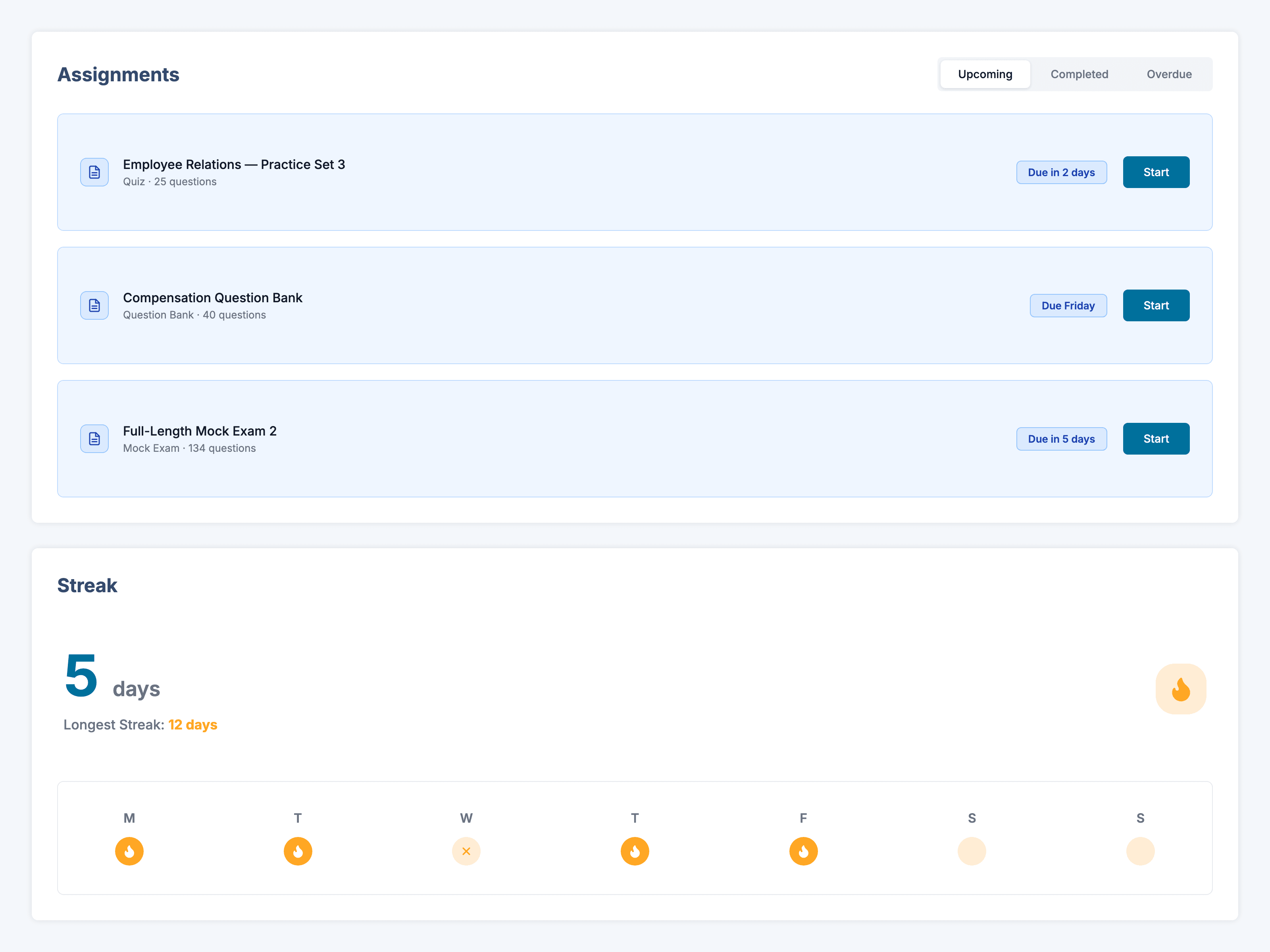
Assignments with due dates beside the streak card: a five-day flame streak and a week row of study days

Three full-length timed mocks with a countdown clock, a question palette, and flagging — the same rhythm as test day.
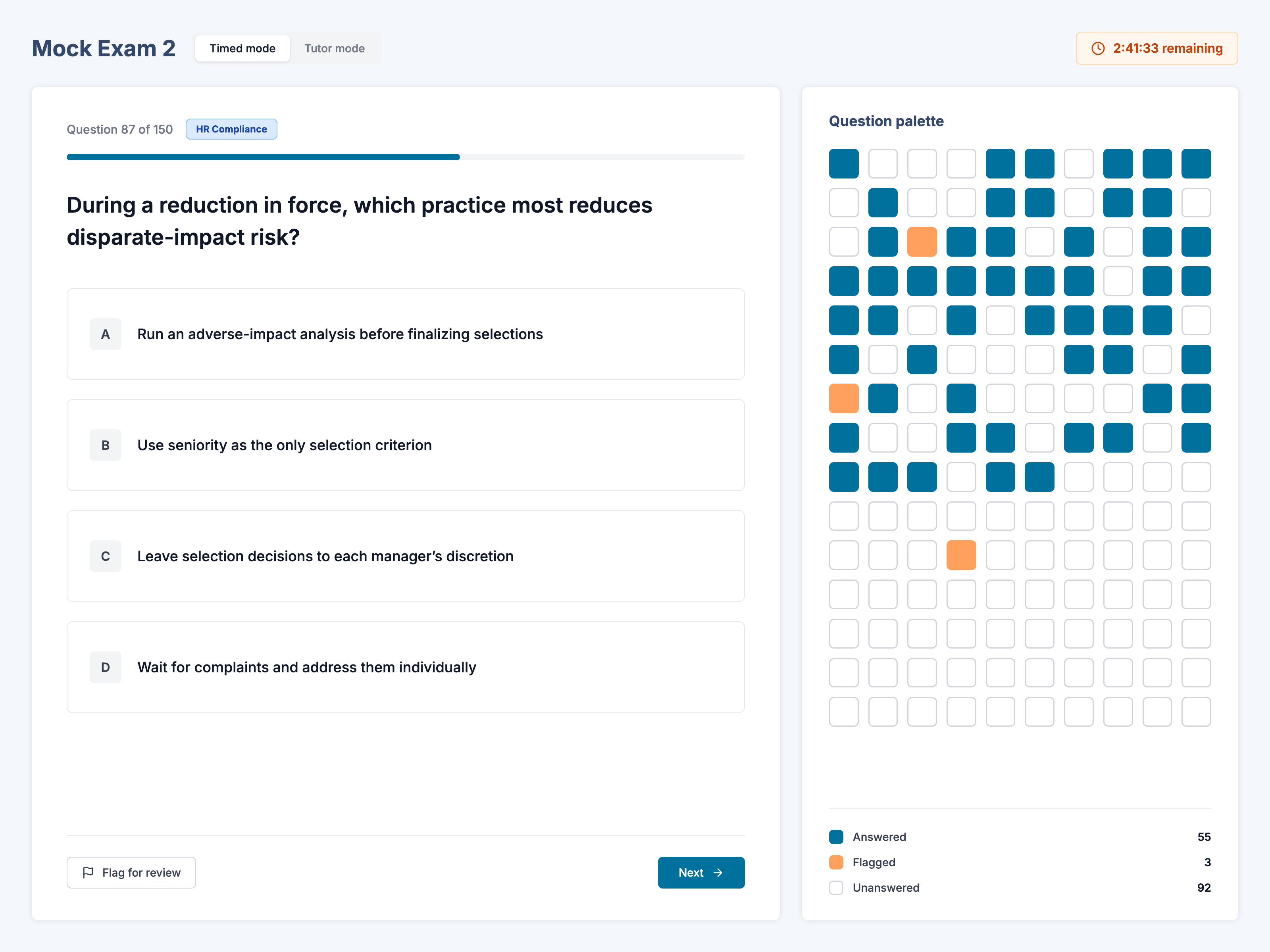
A timed HR mock exam with countdown clock, question palette, and flag-for-review controls

One accuracy score, a week-by-week trend against your cohort, and per-domain accuracy — so "am I ready?" stops being a feeling.
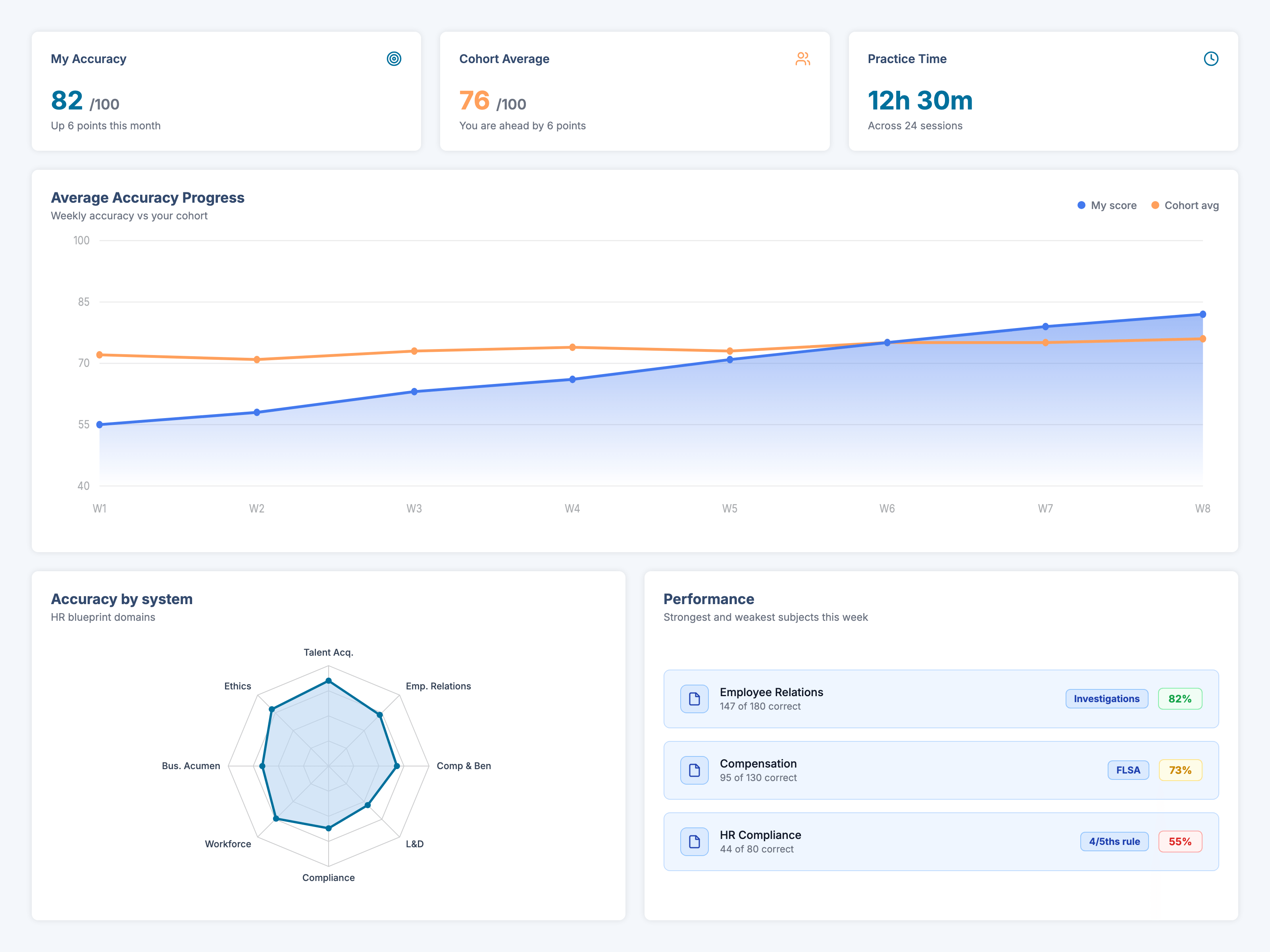
The analytics dashboard: accuracy versus cohort trend, an accuracy-by-domain radar, and strongest and weakest subjects

Highlight inside any explanation and save it as a note. Every note stays linked to the question it came from.
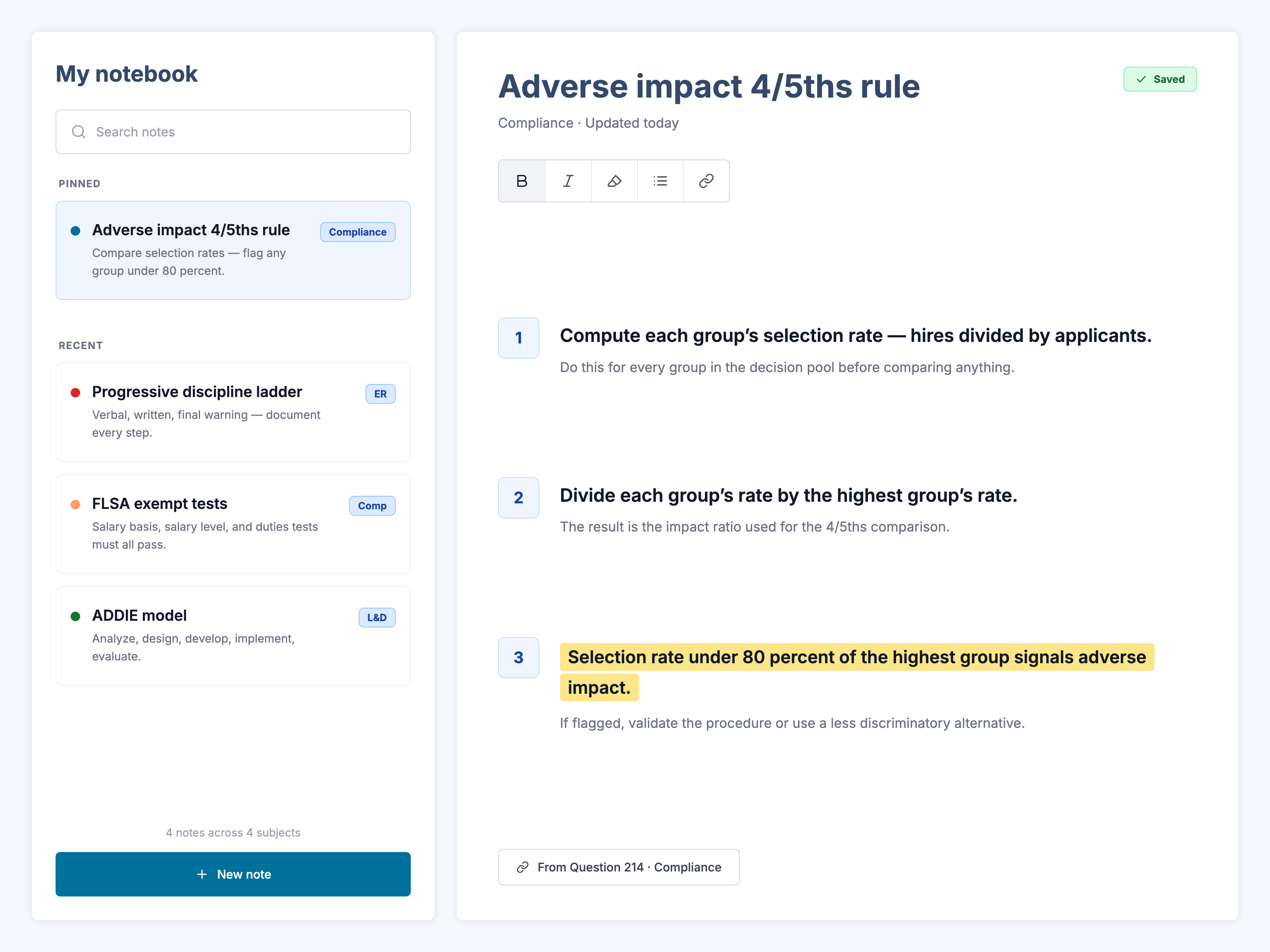
The built-in notebook: a saved note on the adverse impact four-fifths rule, highlighted text, and a link back to its question
In their words

What candidates tell us

The SJI questions were the part I was scared of. Drilling them here, with the little breakdown of why the best answer wins, made the real ones feel familiar. Wish I'd found this before paying for two other apps.
Jordan W.SHRM-CP · HR Generalist
I studied on lunch breaks and after my kids went to bed, that's all the time I had. My first practice mock in March showed I wasn't ready yet — I followed the plan and passed when the May window opened.
Amanda C.SHRM-CP · First attempt

Passed with PrepSolution? Share your story.

Share your story
The book

The Complete SHRM-CP & SHRM-SCP Book

Both credentials in one volume, current to the 2026 BASK — plain-language theory, diagrams that teach in pictures, and a written rationale for every practice question.

The Complete SHRM-CP & SHRM-SCP Book — table of contents

6 parts · 22 chapters

Knowledge domain · The BridgeThe People Domain
  1. 01HR Strategy — Mission, the Ulrich model, HR ROI, scorecards
  2. 02Talent Acquisition — Workforce planning, selection, adverse impact
  3. 03Employee Engagement and Retention — Engagement models, turnover cost, stay interviews
  4. 04Learning and Development — Andragogy, ADDIE, Kirkpatrick, the 9-box grid
  5. 05Total Rewards — Pay structure, FLSA, pay equity, executive comp
Knowledge domain · The MapThe Organization Domain
  1. 06Structure of the HR Function — Three-legged stool, shared services, HR tech
  2. 07Organizational Effectiveness and Development — OD interventions, change models, culture
  3. 08Workforce Management — Job design, RIF methodology, the WARN Act
Knowledge domain · The MapThe Workplace Domain
  1. 09Employee and Labor Relations — NLRA, bargaining, investigations, discipline
  2. 10Technology Management — HRIS, people analytics, AI bias, data privacy
  3. 11Global Workforce — Expatriates, immigration, cross-border data
  4. 12Risk Management — Enterprise risk, OSHA, continuity, wellbeing
  5. 13Ethics and Corporate Social Responsibility — SHRM Code, conflicts, ESG, stakeholders
  6. 14U.S. Employment Law and Regulations — Title VII, ADA, FMLA, recent rulings
Behavioral cluster · The CompassLeadership
  1. 15Leadership and Navigation — Influence without authority, change leadership
  2. 16Ethical Practice — Integrity, speaking up, confronting violations
  3. 17Inclusion and Diversity — The 2026 environment, structural inclusion
Behavioral cluster · The CounselInterpersonal
  1. 18Communication — Audience, channel, the difficult conversation
  2. 19Relationship Management — Trust, stakeholders, conflict, negotiation
Behavioral cluster · The LensBusiness
  1. 20Business Acumen — Financial literacy, the CHRO, M&A and capital
  2. 21Consultation — Diagnosing challenges, designing HR solutions
  3. 22Analytical Aptitude — Evidence-based decisions, statistical literacy
See the full book
1,600+pages22chapters380diagrams330practice questions

Included with every Complete Pass System plan — read it on any device, no extra cost.

SHRM-CP, SHRM-SCP, and SHRM BASK are trademarks of the Society for Human Resource Management. This independent study resource is not affiliated with, endorsed by, or sponsored by SHRM.

Chapter 01

HR Strategy

Strategy & People

Free chapter · The book

Read a full chapter, free

Chapter 01 · HR Strategy · Strategy & People

Flashcards

800+ flashcards, zero filler

The statutes, frameworks, and one-line differentiators that have to be automatic on exam day — tagged by BASK topic.

  • HR Structure

    Ulrich’s Three-Legged Stool

    Shared services run transactions, centers of excellence hold deep expertise, business partners consult with leadership.

  • Labor Relations

    Mediation vs. Arbitration

    A mediator facilitates a voluntary, nonbinding agreement; an arbitrator hears evidence and issues a binding decision.

  • Employment Law

    COBRA Continuation Coverage

    Employers with 20 or more employees; coverage runs 18 or 36 months, at up to 102 percent of premium.

  • Ethical Practice

    Code of Ethics vs. Code of Conduct

    Ethics states broad guiding principles; conduct sets the specific behavioral rules for concrete situations.

  • Learning & Development

    Kirkpatrick Level 2 vs. Level 3

    Level 2 measures what was learned in training; Level 3 measures whether it shows up on the job.

  • Relationship Management

    BATNA

    Your best alternative if negotiation fails — it sets your leverage and tells you when to walk away.

  • HR Strategy

    The Balanced Scorecard

    Kaplan and Norton’s four perspectives: financial, customer, internal processes, learning and growth. HR lives in the last one.

  • Inclusive Mindset

    Halo vs. Horns Effect

    One positive trait inflates the whole impression; one negative trait unfairly drags everything down.

  • Analytical Aptitude

    Correlation vs. Causation

    Correlation shows two variables move together; causation proves one actually produces the other.

  • Total Rewards

    Broadbanding

    Fewer, wider pay bands with spreads past 100 percent — easier lateral moves, but watch for pay inequity.

  • Employment Law

    FMLA Key Employee Exception

    Reinstatement can be denied to the highest-paid 10 percent of salaried staff when return causes grievous economic injury.

  • Engagement & Retention

    Stay Interviews

    Structured conversations with current employees about what keeps them — fix engagement before turnover, not after it.

  • Workforce Management

    The Nine-Box Grid

    Performance on one axis, potential on the other — nine cells that keep promotion and succession calls objective.

  • Global Workforce

    Repatriation

    Reintegrating an expatriate back home — manage reverse culture shock and career alignment, or lose the hire.

  • Business Acumen

    SWOT Analysis

    Internal strengths and weaknesses against external opportunities and threats — the environmental-scanning staple.

Sixteen cards from the live deck, lightly compressed to fit the card face. Every card in the product carries the full detail.

Detailed rationales

Wrong answers turn into cheat sheets

Miss a question and the explanation comes back as a color-coded table — the rule, the trap, and the numbers side by side. Far easier to remember than a paragraph.

answers get a coded diagram
2 in 5
coded teaching diagrams
500+
comparison tables
360
  • Side-by-side comparisons
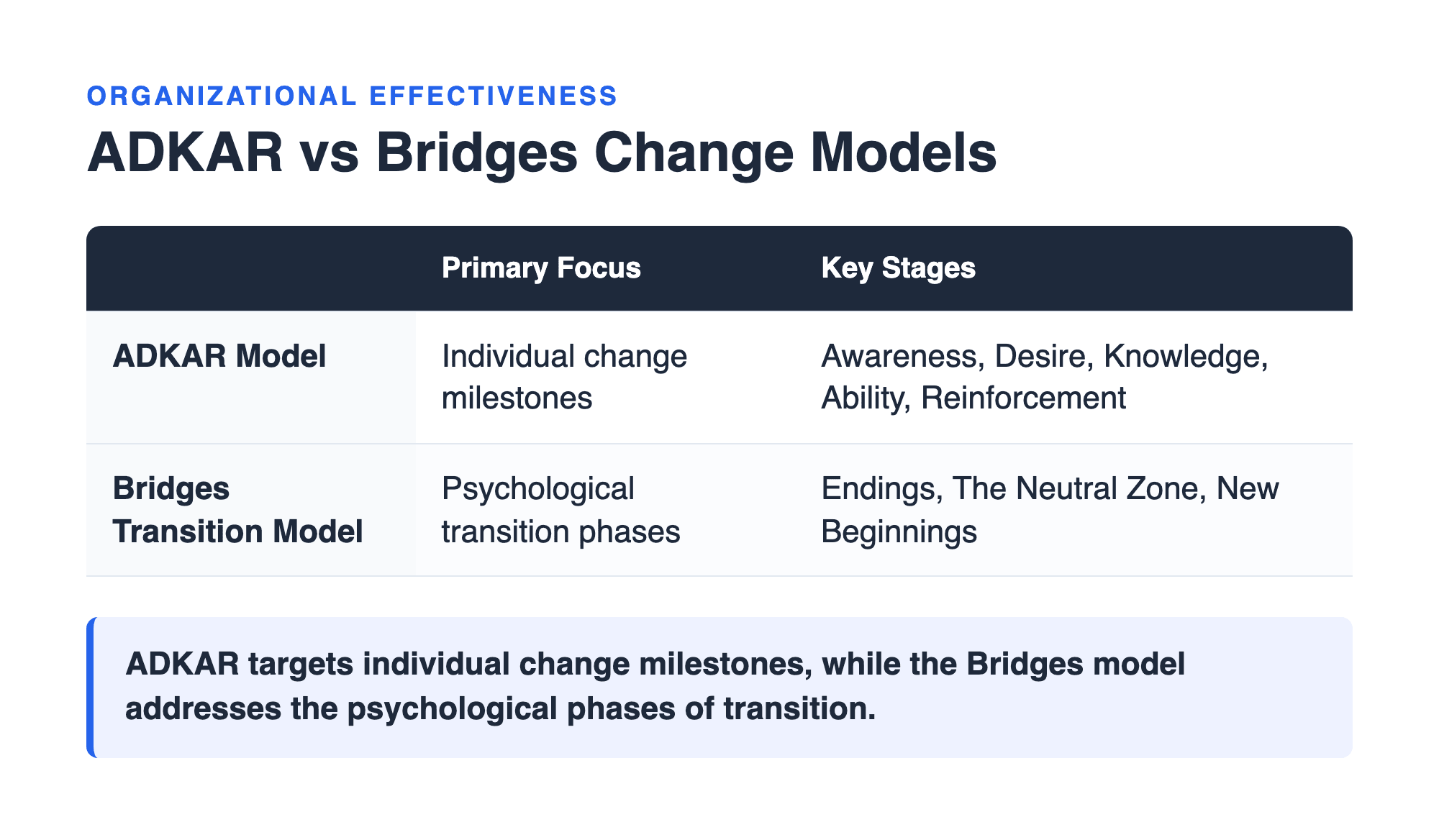
    Coded teaching table from a SHRM-CP explanation: ADKAR versus Bridges change models compared by primary focus and key stages, with the takeaway that ADKAR targets individual milestones while Bridges addresses psychological transition
  • Process flows
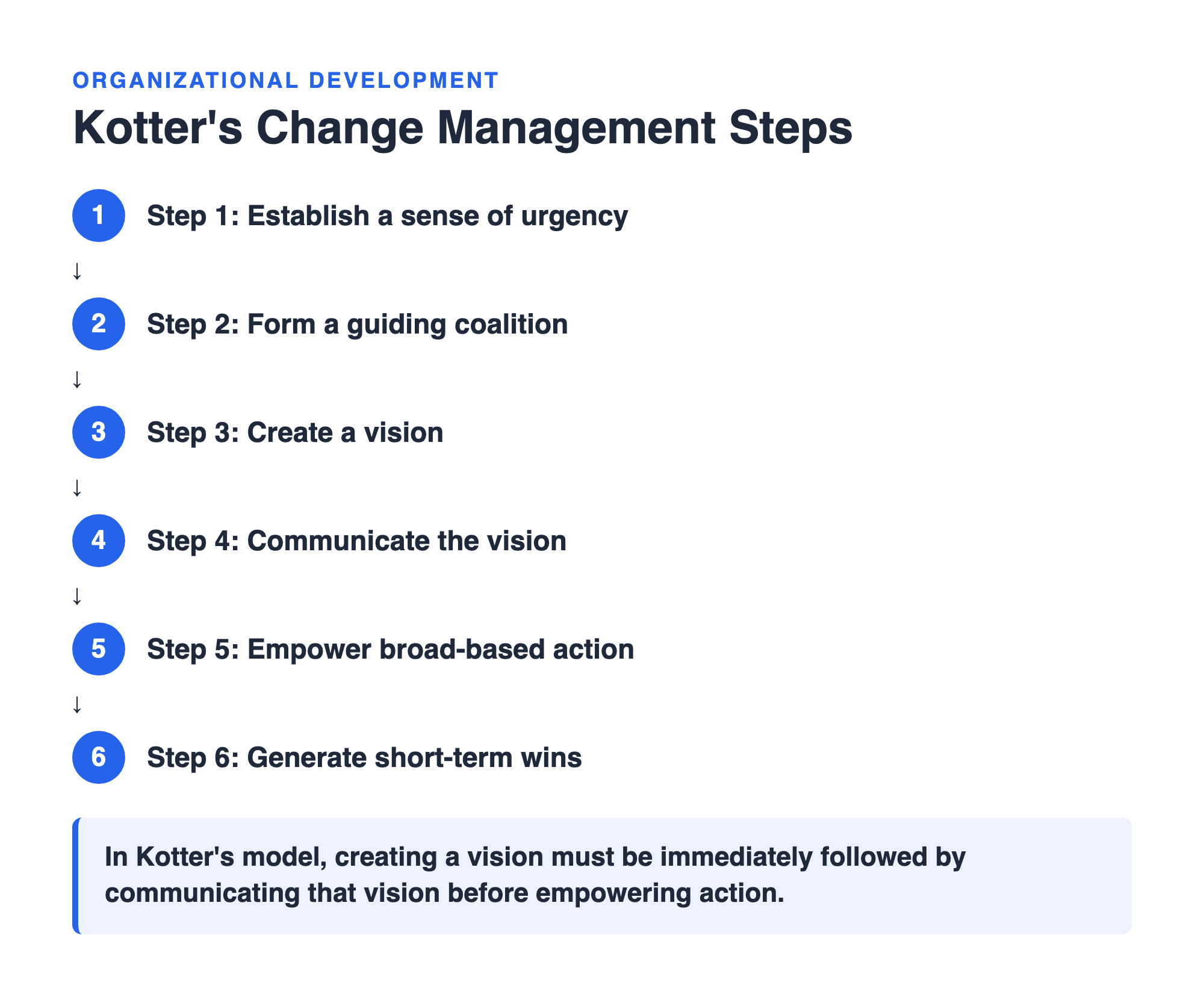
    Coded teaching diagram of Kotter’s change management steps in order, from establishing urgency to generating short-term wins, with the note that the vision must be communicated before empowering action
  • Frameworks, mapped
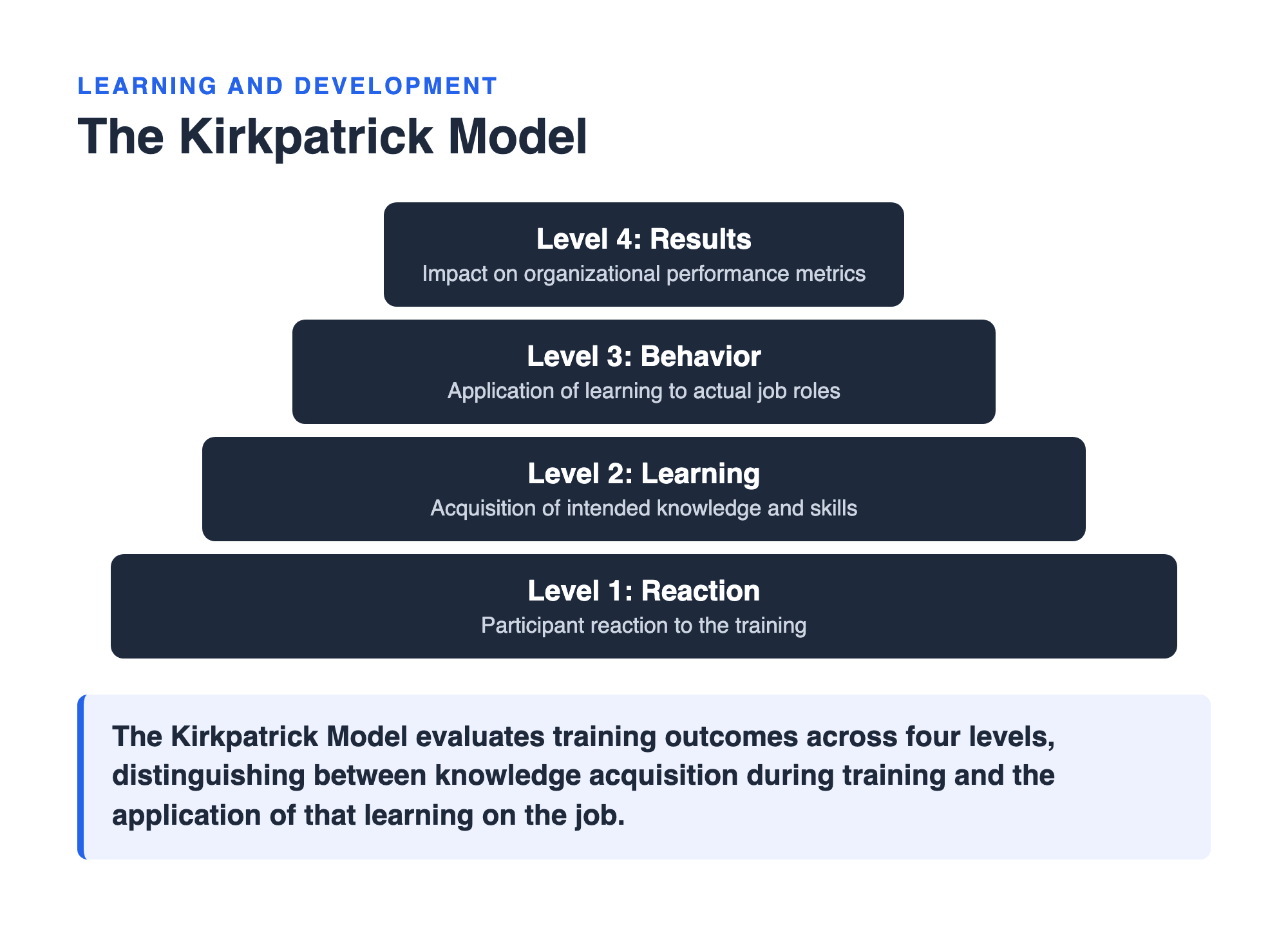
    Coded teaching pyramid of the Kirkpatrick Model: Reaction, Learning, Behavior, and Results stacked as four levels, separating knowledge gained in training from application on the job

Counted from the live bank: 2 in 5 QBank questions carry a coded teaching diagram — 500+ in all, 360 of them side-by-side comparison tables. Every label is composited from the question’s own text, so spelling and terminology match exactly.

Short on time

Exam in a few days? We've got you.

$39.99one time

One month of access · no subscription

Inside the Starter

  • The Adaptive QBank, 1,500+ questions
  • Rapid Recall flashcards, 200+ cards
  • The Pass Path study calendar
  • The Exam Mirror, 1 timed mock exam

Only in the Complete Pass System

  • SHRM-CP Video Course (Animated) — 54 lessons, 13+ hours
  • The Complete SHRM-CP & SHRM-SCP Book — 1,600+ pages, 380 diagrams
  • The Pass Guarantee, which extends your plan free if you don’t pass
Or see the SHRM-CP Complete Pass System

The Pass Guarantee

Complete the plan and the mocks. If you don't pass, you keep studying free.

If you complete the study plan, take all three mock exams, and don’t pass, we extend your plan free for the same length you bought — a 3-month plan gets 3 more months, a 6-month plan gets 6, a 12-month plan gets 12.

  1. 1

    Finish your study plan and all three mock exams.

  2. 2

    Sit the exam. If you don’t pass, send your score report within 30 days.

  3. 3

    Your plan extends free for the same length you bought.

Included with every Complete Pass System plan.

Compared with the other SHRM-CP options

Prices and features re-verified on July 17, 2026.

SHRM-CP prep options compared feature by feature
FeaturePrepSolutionSHRM Prep SystemMometrixPocket Prep
Full access price$249.99 / 12 mo$820 to $1,330$129.99 / mo$20.99/mo or $124.99/yr
One-time payment (no subscription)YesYesNoNo
Pass guarantee includedYesNoNo3 free months
Total practice questions1,500+2,700+1,250+1,600
Full-length timed mock exams3 × 134qIncluded8 testsPartial
Digital study book included1,600+ page bookPrint books +$200$44.99 separatelyNo
Video course included54 lessons, 13+ hoursInteractive lessons160+ lessonsNo
Adaptive engine (targets weak areas)YesPartialNoPartial

Pricing and feature data pulled from each provider’s public website and re-verified on July 17, 2026. SHRM range spans member online-only ($820) to nonmember with printed books ($1,330). PrepSolution is our product; we are not affiliated with SHRM, Mometrix, or Pocket Prep.

Who it is for

Built for the candidate, not the textbook

Both credentials in one volume. Whoever you are coming to it, the book meets you there.

  • The first-time candidate

    You have the HR experience but have never sat this exam. The structure and the judgment the situational items reward are built for you.

  • The seasoned pro

    You know the work cold but have not tested in years. Timed chapter quizzes rebuild your test stamina before the day.

  • The career changer

    You are entering HR from another field. Plain-language theory makes the dense frameworks land the first time, without the jargon wall.

  • The SHRM-SCP leader

    The senior exam runs a harder pass rate. The strategic-level reasoning and the business cluster are written for the executive lens.

  • The team or sponsor

    Certifying a cohort. One consistent source, one blueprint, and a shared vocabulary across everyone sitting the exam this window.

  • The student on track

    Eligible through your program and testing early. The study calendar paces the whole book around coursework and a real exam date.

What the SHRM-CP is worth

SHRM's own research ties certification to higher pay, and the HR roles this credential serves sit well above the median US wage.

14–15%higher reported salaries for SHRM-certified professionals vs non-certified peers2022 SHRM HR Careers Study
$75,940median annual pay, US human resources specialistsBLS OES, May 2025
$149,280median annual pay, US human resources managersBLS OES, May 2025

Published figures from the cited sources — individual pay varies by market, role, and experience.

Blueprint coverage

4 content areas, weighted the way the BASK 2026 exam weights them.

  1. Behavioral Competencies50%
  2. People19%
  3. Organization18%
  4. Workplace13%

Frequently asked questions

Everything you need to know about SHRM-CP prep.

About SHRM-CP prep

The course has 54 lessons across 8 tracks, delivered in 92 videos totaling 13 hours and 41 minutes. It covers the exam roadmap, SJI decision skills, HR knowledge, Knowledge Plus topics, U.S. employment law, behavioral competencies, guided practice, and exam-day preparation. Open the curriculum in the video course section to see every lesson, video part, and runtime.

Yes. The 3-, 6-, and 12-month Complete Pass System plans include the full course, QBank, mock exams, digital book, and flashcards. Watch and revisit the lessons online throughout your access period. The one-month Starter does not include the video course or book.

No. The SHRM-CP Video Course (Animated) is view-only in your PrepSolution account. An internet connection is required, and you can watch the lessons during your plan’s access period. Video files are not available for download.

Start with the Exam and Study Roadmap and SJI Decision Skills. Use your practice results to choose HR knowledge and Knowledge Plus lessons, then work through employment law, behavioral competencies, and guided practice. Revisit the exam-day track near your test. The curriculum includes study guidance for each track.

PrepSolution brings animated teaching and practice into one Complete Pass System: the SHRM-CP Video Course (Animated), 1,500+ adaptive questions, 3 timed mocks, the visual SHRM book, 800+ flashcards, study calendars, and a pass guarantee. Choose 3, 6, or 12 months of access; the full course is included in each plan.

Yes. Every Complete Pass System plan includes the full digital SHRM book at no extra cost: the visual study guide that teaches the judgment behind every answer, with 380 diagrams that teach in pictures and the exam’s common traps named. You read it online alongside the question bank, so you learn the concept first, then drill it.

SJIs make up approximately 40% of the SHRM-CP exam. They present a realistic workplace scenario and ask you to select the most effective response from four plausible options. Real-world HR experience can actually work against you here because what works in YOUR office may not be what SHRM considers the ideal response. The SJI Decision Skills track in our SHRM-CP Video Course (Animated) teaches PREP, SIEVE, the Priority Ladder, and the Auditor Test, then applies the methods in guided practice.

All content is aligned to BASK 2026 — 8 behavioral competencies in 3 clusters, plus 3 HR knowledge domains (People 19%, Organization 18%, Workplace 13%). If your materials still list 9 competencies, they’re outdated.

Yes. The exam tests what SHRM considers the ideal response, not what works in your specific organization. Experienced HR professionals often fail SJIs because they answer based on their company’s culture rather than SHRM’s framework.

SHRM recommends 80–100 hours over 10–14 weeks. Our 12-week calendar structures this into daily sessions of 60–90 minutes. The 8-week accelerated path requires about 12–15 hours per week.

PrepSolution for the SHRM-CP

The SHRM-CP Complete Pass System is built as a complete prep path: 1,500+ practice questions aligned to the BASK 2026, each with a written rationale, plus 3 full-length mock exams. Every question is written and reviewed by credentialed professionals who hold the SHRM-CP, and Complete Pass System plans carry the pass guarantee: finish the study plan and mocks, and if you don’t pass, your access is extended free.

SHRM-CP prep starts at $89.99 one-time and runs up to $249.99 for the longest Complete Pass System plan. Every plan is a single payment for a fixed access length — no subscription and no auto-renewal — and current prices are always shown on this page’s pricing section.

Candidates usually weigh PrepSolution against SHRM Learning System, Pocket Prep, Mometrix. PrepSolution’s approach: every question is written by credentialed SHRM-CP holders, every answer includes a full rationale, plans are one-time payments rather than subscriptions, and the Complete Pass System includes the pass guarantee. When comparing, check question counts, which formats are included at each price, and access length.

About PrepSolution

You’ll receive an email with your login credentials within 5 minutes of purchase. If you don’t see it, check your spam folder or contact support@prepsolution.com.

No. Every plan is a one-time payment. You pay once and get access for the full length of the plan you choose — 3, 6, or 12 months. There are no recurring charges, no auto-renewals, and no hidden fees.

If you complete the study plan, take all three mock exams, and don’t pass, we extend your plan free for the same length you bought — a 3-month plan gets 3 more months, a 6-month plan gets 6, a 12-month plan gets 12. This guarantee is included exclusively with the Complete Pass System.

Yes. If you purchase and decide it’s not the right fit within 24 hours, contact support@prepsolution.com and we’ll process a full refund. No questions asked.

No. PrepSolution is an independent exam preparation company. We are not affiliated with, endorsed by, or sponsored by SHRM, PMI, AACN, or any certification body. Our content is developed based on publicly available exam blueprints and content outlines.

Many candidates come to PrepSolution after a failed first attempt. The most common reason for failure is approaching judgment-based questions with workplace instinct rather than a systematic framework. Start with a diagnostic mock exam to identify your weakest domains, then follow the targeted study plan.

Many employers cover professional development costs including exam prep materials. After purchase, you’ll receive a receipt that can be submitted for reimbursement. Contact support@prepsolution.com if you need a customized invoice.

SHRM-CP Complete Pass System

6 months · $149.99Pass Guarantee includedChange plan

Didn't pass last time?

Failing once doesn't mean you can't pass.

Retake rules, real costs, and what to change before you pay the exam fee again.

Read the SHRM-CP retake plan

Employer paying?

Get your SHRM-CP prep reimbursed.

A ready-to-send approval email and the receipt your finance team asks for.

Copy the approval email
SHRM-CP study materials