SLP Praxis · Aligned to the Praxis 5331 blueprint
SLP Praxis Complete Pass System

The Adaptive Platform1 / 3
$21.67/mo · $129.99 billed once · 6 months of access
- 1,181 original questions on the Praxis 5331 blueprint
- 3 timed mock exams, 132 questions each
- Verified against ASHA scope of practice and EBP norms
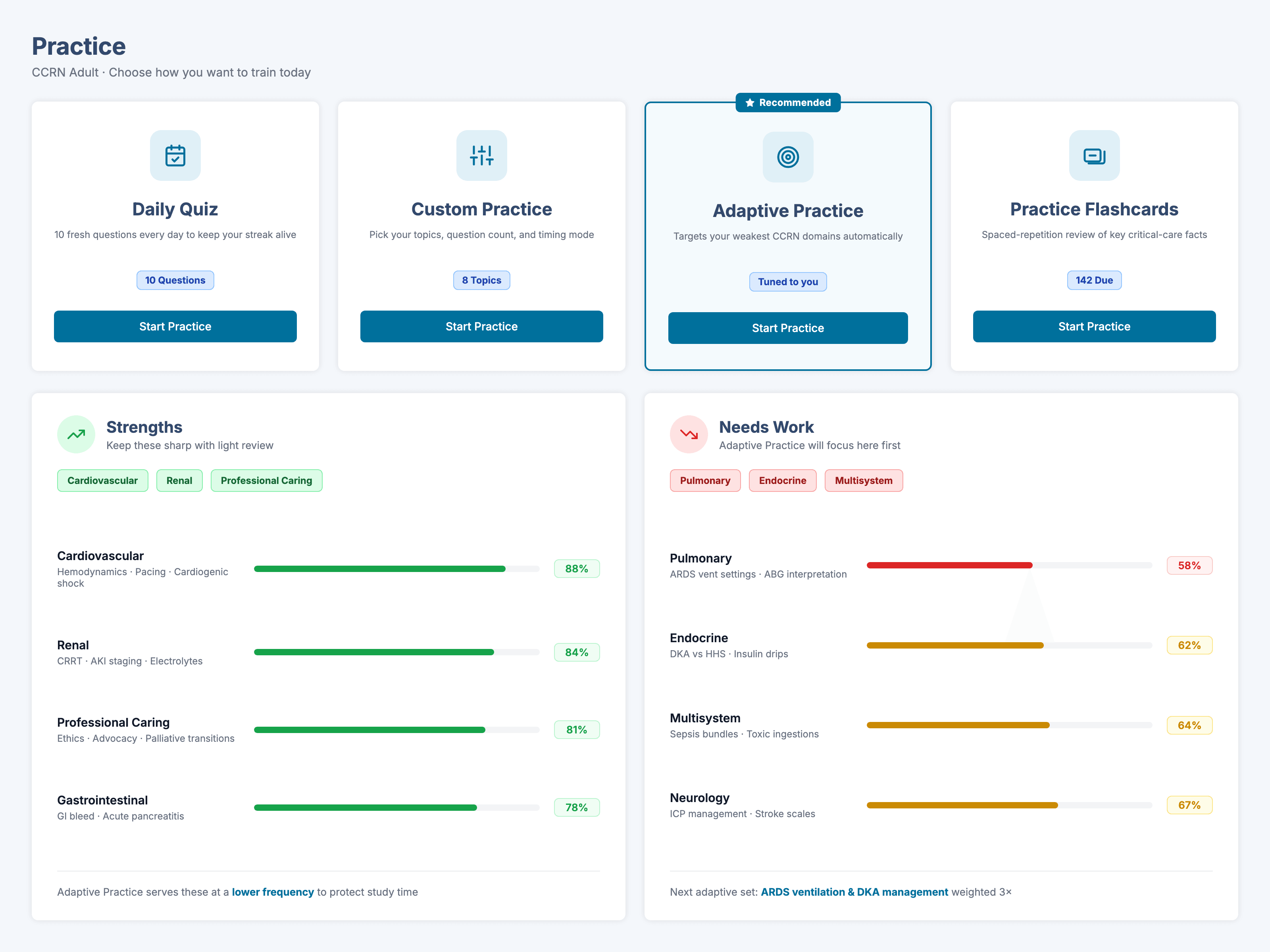
- Adaptive Practice that targets your weakest areas
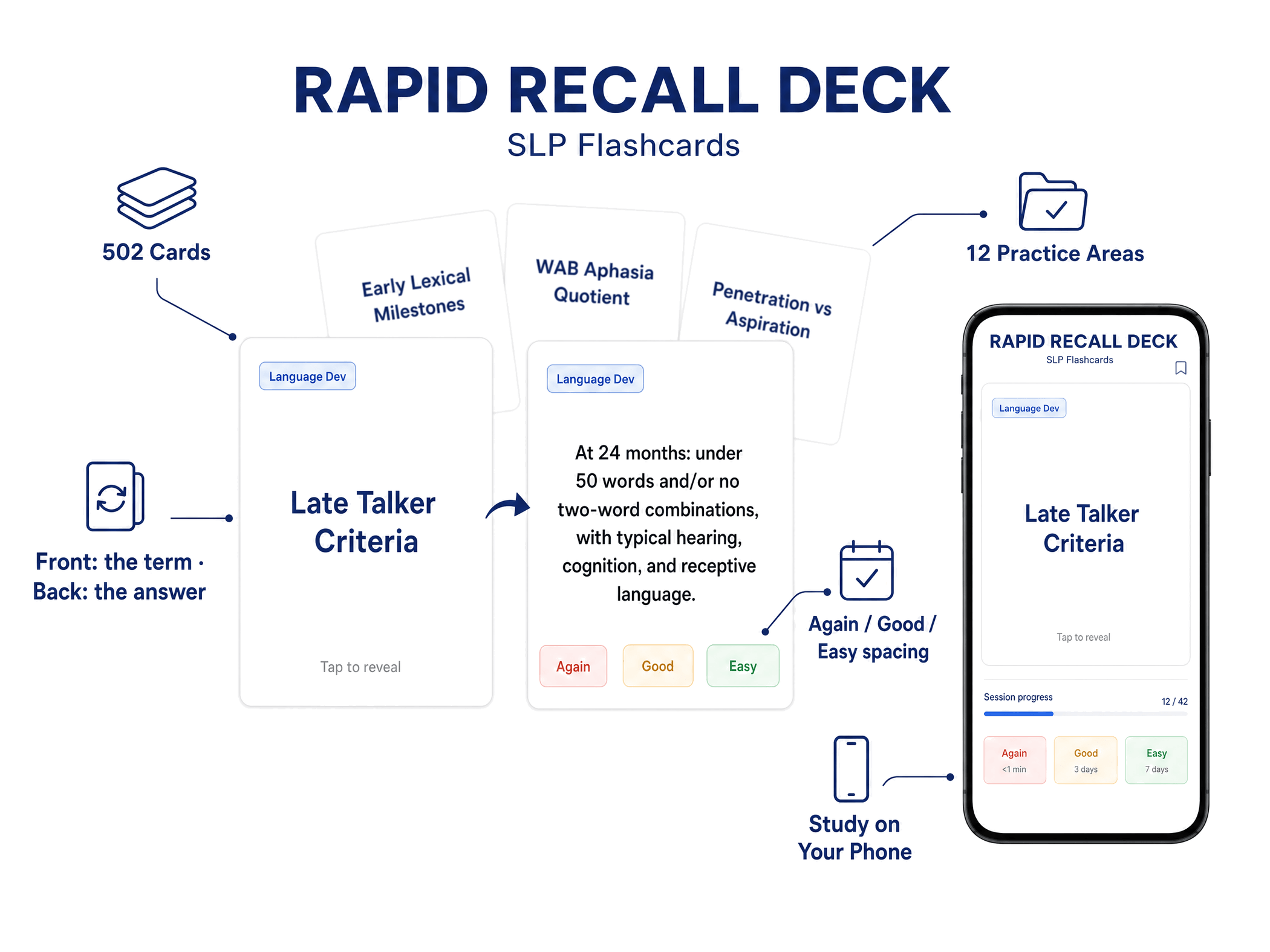
- 502 flashcards across 12 disorder and foundation areas
- Detailed rationale with every answer
- Reviewed by ASHA-certified speech-language pathologists
- Pass Guarantee on every Complete Pass System plan
Access length
One-time payment · 6 months · No subscription
- Instant access
- Phone, tablet & desktop
- Secure checkout

The Pass Guarantee
- Complete the study plan and all three mock exams, then sit your exam
- If you don't pass, your plan extends free for the same length you bought
- Send your score report within 30 days of your exam date
- Included with every Complete Pass System plan
Access and delivery
- Login details arrive by email within 5 minutes of purchase.
- Fixed access length, no auto-renewal.
- Every update published during your access is included.
- Works on phone, tablet and desktop.
Employer reimbursement
- Many employers cover exam prep as professional development.
- Every purchase comes with a receipt; custom invoices on request.
1,181
Original questions
Aligned to the Praxis 5331 blueprint
3
Mock exams
502
Flashcards
12 disorder & foundation areas
The SLP Praxis Complete System
What’s in the box
Two formats, one Praxis 5331 blueprint. The QBank builds the clinical judgment the exam rewards; the deck locks in the norms and milestones.
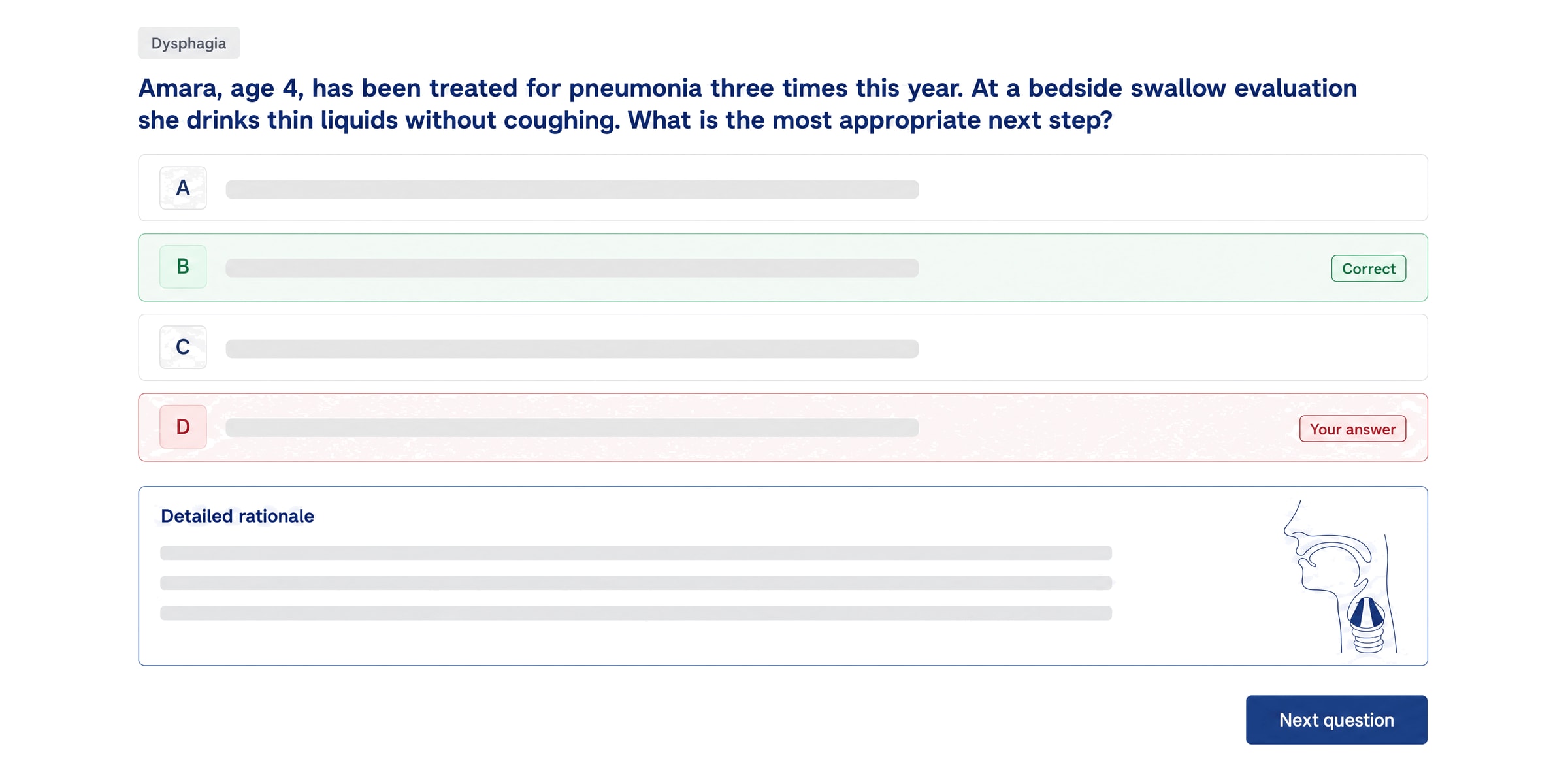
Practice that studies you back
Every session feeds the engine — it learns what you miss and rebuilds your next session around it.
Answer questions and the bank quietly rebalances — your weakest content areas get more reps, automatically, after every single session.
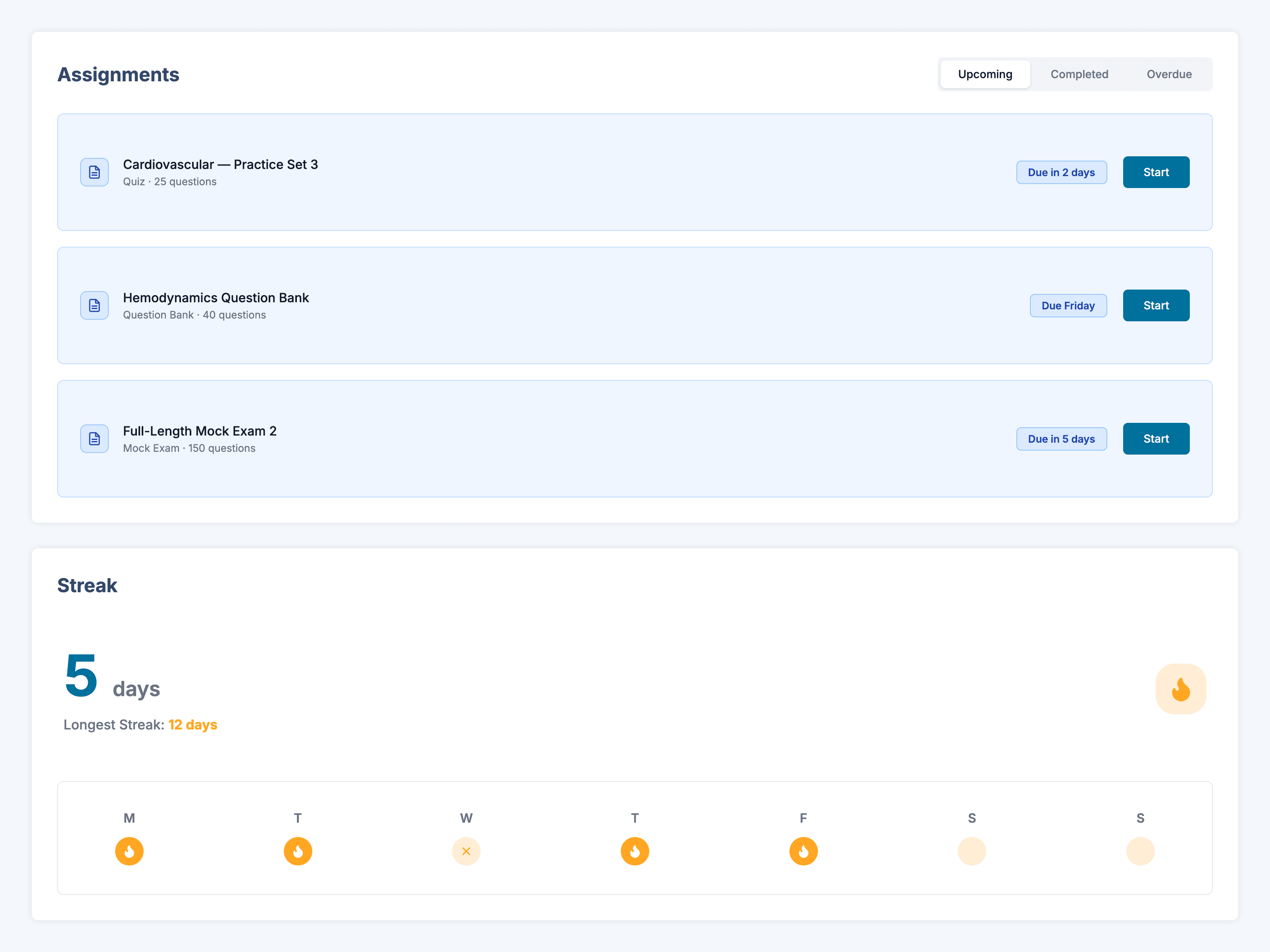
Daily quizzes, assigned practice sets, and a streak that keeps you honest between grad classes and clinic placements.
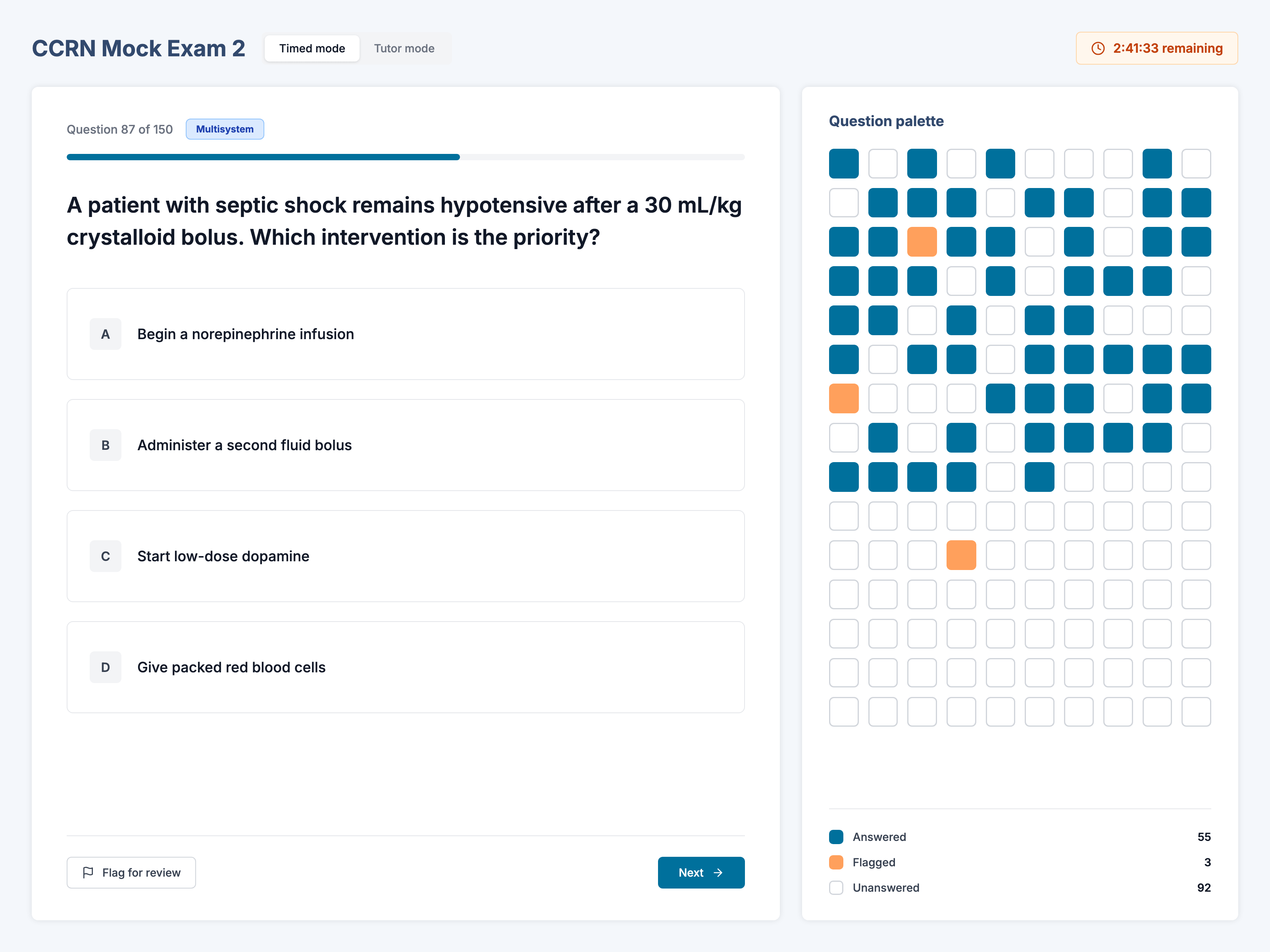
Three full-length timed mocks with a countdown clock, a question palette, and flagging — the same rhythm as test day.
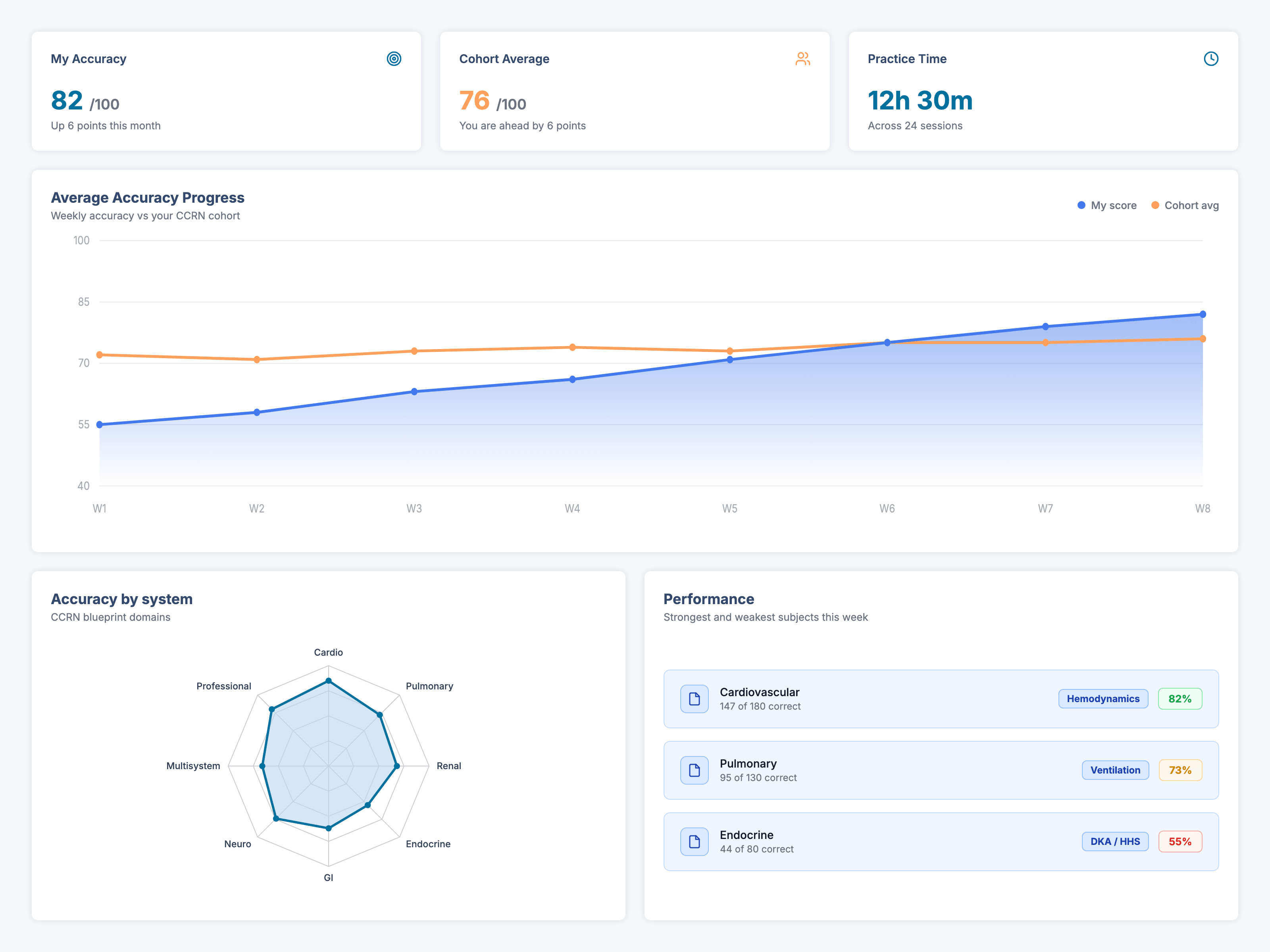
One readiness score, a week-by-week trend, and per-area accuracy — so "am I ready?" stops being a feeling.
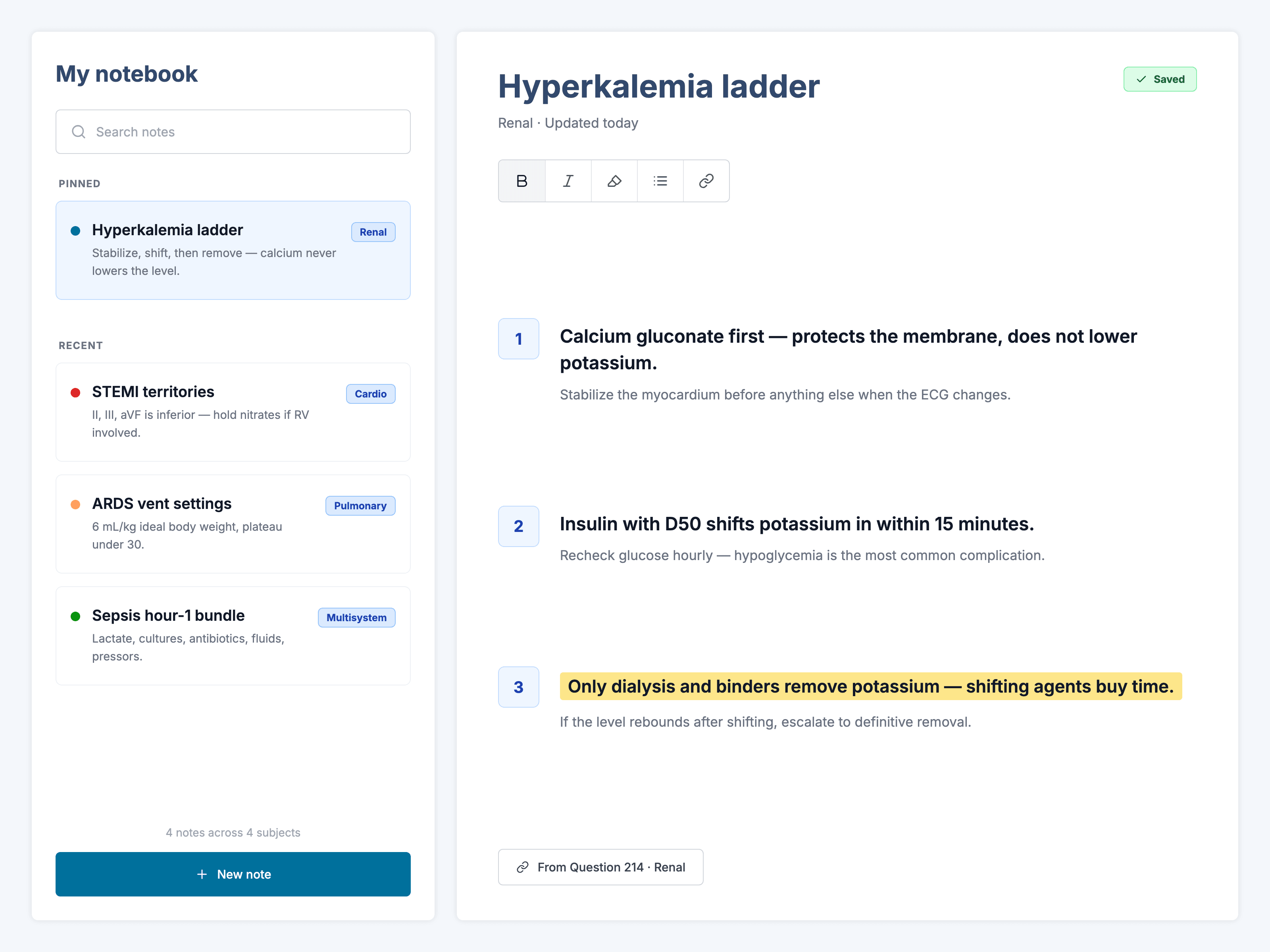
Highlight inside any explanation and save it as a note. Every note stays linked to the question it came from.
502 flashcards, zero filler
The norms, milestones, and classification systems the Praxis expects on reflex — tagged by practice area.
- Language Dev
Early Lexical Milestones
First words around 12 months; a ~50-word expressive vocabulary plus first two-word combinations by 18–24 months.
- Language Dev
Brown's Earliest Morpheme
Present progressive -ing (without auxiliary) emerges first, around 19–28 months — before plurals, possessives, articles, and past tense.
- Aphasia
WAB Aphasia Quotient
The WAB AQ (0–100) grades severity from spontaneous speech, comprehension, repetition, and naming. Below 93.8 indicates aphasia.
- Aphasia
Broca's Area
Left inferior frontal gyrus (Brodmann 44/45), fed by the superior division of the left middle cerebral artery.
- Aphasia
Wernicke's Area
Posterior superior temporal gyrus (Brodmann 22), inferior division of the left MCA. Motor programming is intact, so output stays fluent but empty.
- Dysphagia
Penetration vs Aspiration
Penetration: material enters the laryngeal vestibule but stays at or above the true vocal folds. Aspiration: it passes below the folds into the trachea.
- Dysphagia
IDDSI Framework
8 levels (0–7). Drinks run 0–4 (Thin to Extremely Thick); foods run 3–7 (Liquidised to Regular). Levels 3–4 overlap drinks and foods.
- Dysphagia
3-oz Water Swallow Test
Screening: drink 90 mL uninterrupted. Coughing, choking, or a wet-hoarse voice within a minute is a fail — flagging aspiration risk for instrumental study.
- Fluency
Stuttering Onset Age
Developmental stuttering begins between about 2 and 5 years, most commonly near 3. Onset after 8–9 suggests a neurogenic or psychogenic cause.
- Fluency
Preschool Recovery Rate
Roughly 75–80% of preschool children who stutter recover, most within 1–2 years of onset — why risk factors drive treat-now vs monitor.
- Speech Sounds
Intelligibility by Age
To unfamiliar listeners: about 50% at age 2, 75% at age 3, near 100% at age 4. A 3-year-old under 75% warrants concern.
- Speech Sounds
PCC Severity Bands
Percentage of Consonants Correct: above 85% mild, 65–85% mild-moderate, 50–65% moderate-severe, below 50% severe — from connected speech.
- Audiology
Degrees of Hearing Loss
Normal −10 to 15 dB HL; slight 16–25; mild 26–40; moderate 41–55; moderately severe 56–70; severe 71–90; profound 91+.
- Audiology
EHDI 1-3-6 Benchmarks
Hearing screened by 1 month, diagnosed by 3 months, early intervention by 6 months — tied to markedly better language outcomes.
- Voice
Nodules vs Polyps
Nodules: bilateral, at the anterior 1/3–posterior 2/3 junction, from phonotrauma — voice therapy first. Polyps: unilateral, fluid-filled, often surgical.
Sixteen cards from the live deck, lightly compressed to fit the card face. Every card in the product carries the full detail.
The Pass Guarantee
Complete the plan and the mocks. If you don't pass, you keep studying free.
If you complete the study plan, take all three mock exams, and don’t pass, we extend your plan free for the same length you bought — a 3-month plan gets 3 more months, a 6-month plan gets 6, a 12-month plan gets 12.
- 1
Finish your study plan and all three mock exams.
- 2
Sit the exam. If you don’t pass, send your score report within 30 days.
- 3
Your plan extends free for the same length you bought.
Included with every Complete Pass System plan.
What the CCC-SLP is worth
The Praxis is the gate to CCC-SLP licensure — and the profession it unlocks pays well above the median US wage, per the government and ASHA’s own survey.
Published figures from the cited sources — individual pay varies by market, role, and experience.
Blueprint coverage
3 content areas, weighted the way the Praxis 5331 exam weights them.
- Foundations & Professional Practice33%
- Screening, Assessment & Diagnosis33%
- Planning & Treatment33%
Frequently asked questions
Everything you need to know about SLP Praxis prep.
About SLP Praxis prep
The Speech-Language Pathology Praxis (test code 5331) is 132 selected-response questions in 150 minutes, delivered on computer — at a test center or at home with online proctoring. Content splits evenly across three categories: Foundations & Professional Practice, Screening/Assessment/Evaluation/Diagnosis, and Planning/Implementation/Evaluation of Treatment, spanning the Big Nine practice areas.
Scores are reported on a 100–200 scale. ASHA requires 162 for CCC-SLP certification, and state licensure boards set their own passing scores — most reference the same exam. To count toward certification, have ETS send scores directly to ASHA (recipient code 5031).
Per ASHA’s national summary, the 2024–25 pass rate across all examinees was 83.0% with a mean score of 172 — meaning roughly 1 in 6 attempts falls short. The most common failure mode is treating it as a memorization test: the exam leans on applied clinical judgment, which is exactly what vignette-based practice builds.
ASHA recommends taking it no earlier than the completion of your graduate coursework and clinical practicum, or during your Clinical Fellowship. Note the certification clock: scores older than 5 years are not accepted, and you have 2 years from your certification application to complete all requirements.
ETS requires a 28-day wait before rescheduling the same test. Because the exam weights all three categories equally, our per-area analytics pinpoint which of the twelve practice areas cost you the most points — so a retake plan targets the actual gaps.
No. PrepSolution is an independent study resource. Praxis is a trademark of ETS, and CCC-SLP is a certification of ASHA. Every question here is original — written to ASHA scope of practice and evidence-based norms, never reproduced from any exam.
PrepSolution for the SLP Praxis
The SLP Praxis Complete Pass System is built as a complete prep path: 1,181 practice questions aligned to the Praxis 5331 blueprint, each with a written rationale, plus 3 full-length mock exams. Every question is written and reviewed by credentialed professionals who hold the CCC-SLP, and Complete Pass System plans carry the pass guarantee: finish the study plan and mocks, and if you don’t pass, your access is extended free.
SLP Praxis prep starts at $79.99 one-time and runs up to $199.99 for the longest Complete Pass System plan. Every plan is a single payment for a fixed access length — no subscription and no auto-renewal — and current prices are always shown on this page’s pricing section.
Candidates usually weigh PrepSolution against TrueLearn, TherapyEd, ETS practice tests. PrepSolution’s approach: every question is written by credentialed CCC-SLP holders, every answer includes a full rationale, plans are one-time payments rather than subscriptions, and the Complete Pass System includes the pass guarantee. When comparing, check question counts, which formats are included at each price, and access length.
About PrepSolution
You’ll receive an email with your login credentials within 5 minutes of purchase. If you don’t see it, check your spam folder or contact support@prepsolution.com.
No. Every plan is a one-time payment. You pay once and get access for the full length of the plan you choose — 3, 6, or 12 months. There are no recurring charges, no auto-renewals, and no hidden fees.
If you complete the study plan, take all three mock exams, and don’t pass, we extend your plan free for the same length you bought — a 3-month plan gets 3 more months, a 6-month plan gets 6, a 12-month plan gets 12. This guarantee is included exclusively with the Complete Pass System.
Yes. If you purchase and decide it’s not the right fit within 24 hours, contact support@prepsolution.com and we’ll process a full refund. No questions asked.
No. PrepSolution is an independent exam preparation company. We are not affiliated with, endorsed by, or sponsored by SHRM, PMI, AACN, or any certification body. Our content is developed based on publicly available exam blueprints and content outlines.
Many candidates come to PrepSolution after a failed first attempt. The most common reason for failure is approaching judgment-based questions with workplace instinct rather than a systematic framework. Start with a diagnostic mock exam to identify your weakest domains, then follow the targeted study plan.
Many employers cover professional development costs including exam prep materials. After purchase, you’ll receive a receipt that can be submitted for reimbursement. Contact support@prepsolution.com if you need a customized invoice.
SLP Praxis Complete Pass System
6 months · $129.99Pass Guarantee includedChange plan
Didn't pass last time?
Failing once doesn't mean you can't pass.
Retake rules, real costs, and what to change before you pay the exam fee again.
Read the SLP Praxis retake planEmployer paying?
Get your SLP Praxis prep reimbursed.
A ready-to-send approval email and the receipt your finance team asks for.
Copy the approval email
SLP Praxis Complete Pass System
6 months · Pass Guarantee includedChange access length